














































 | 24/07/26 |
Worlding waters
Some Thoughts on this boasblog as a Site of Waterworlding
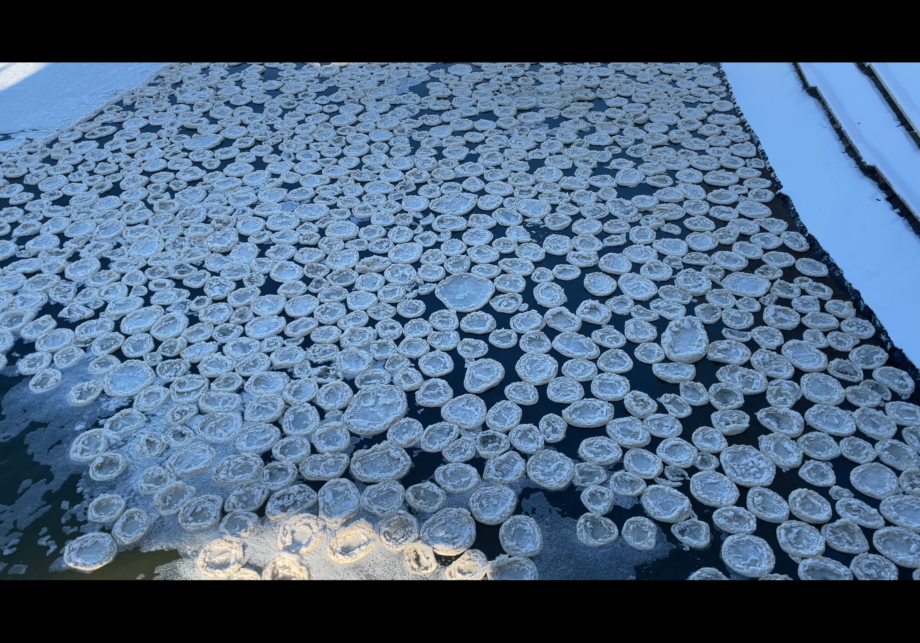
Formerly industrial water in a spectacular form (W. Dietzsch, 2025)
Worlding makes the story possible, but from the margins. (Tsing 2010, 57)
In 2010, Anna Lowenhaupt Tsing wrote a seminal piece entitled “Worlding the Matsutake Diaspora or, can Actor-Network Theory experiment with holism” (Tsing 2010) in which she operationalized the multifaceted theoretical concept of worlding from a methodological perspective.
Taking worlding as a set of connected relations in perpetual motion and transformation, she undertook six different analytical “worlding exercises” to explore the worldings of the Matsutake mushroom. She followed comparative phylogeographical methods, employed classical anthropological holism à la Boas, reflected on her own expanded version of Actor-Network Theory (ANT) and juxtaposed US-American academic work of sustainability management style with the different worlding practices of Japanese scientists. Each exercise yields a different outcome of what the Matsutake mushroom is and what role it plays within the worlding process. In doing so, her understanding of worlding is not only concerned with the description of worlds with all their logics and characteristics, but with what emerges when these worlds are created in everyday life and how they change in their constant interaction with others.
Through her worlding exercises, Anna Tsing also navigates theoretical questions of context and comparison. While she acknowledges that phylogeography and Latourian ANT have in common that they do not allow for discussion of context (ibid, 58) and that ANT in acts of self-purification “rids analysis” from worlding exercises, she simultaneously refers to Marilyn Strathern and her “excessive use of worlding” (ibid, 64). Tsing stated: “Latour refuses context. Strathern disorients her readers by juxtaposing so many combinations of contextual relations that it becomes impossible for the reader to imagine the analysis only resting in only one set.” (ibid, 58). Sympathetic to the analytical value of both approaches, she positions herself between them by proposing a necessary but moderate way of including context in analysis and making (varying) “propositions about context” (ibid, 49), as she demonstrates in her exercises.
In 2015, Frida and Kirsten Hastrup (Hastrup and Hastrup 2015) prominently took up Tsing’s ideas about worlds and worlding and linked them to water as a subject of research. As they noted at the time: „The very object of study – world-making projects in fluid environments – is necessarily a result of empirical and analytical concern for a shared globe, to which ideas of settled and natural entities no longer apply.” (2015, 2) At a time of increasing acknowledgement of unstable, “liquid worlds”, as they called them in reference to Zygmunt Bauman’s notion of “liquid modernity” (Bauman 2000), they were seeking to understand the role water played in “the making and unmaking” of those fluid worlds (Hastrup 2015).
Much has changed since then. While the argument of fluid worlds could initially be read first and foremost as a critical commentary on what had previously been regarded as secure and fixed (solid), critical reflections have since suggested that this emphasis also carries the risk of diverting attention away from what remained untouched by or even actively resisted such “dissolutions”. Additionally, in 2022, Tim Ingold and Cristián Simonetti examined the presumed dichotomy between solid and fluid more closely and argued that this binary is, in fact, the wrong conceptual pair. “Surely, what does not flow – what is stuck, or fixed firmly in place – is, ipso facto, solid. Yet curiously, all that is not solid doesn’t flow.” (Ingold/ Simonetti 2022, 4) They argue that much better terms to pair solidity with are “hollowness, contamination, planarity, liquidity and interruption” and conclude “that matter exists as continuous flux. It is both solid and fluid”. And they add: “[L]iquid is fluid only when it runs, and it will not run if contained. And in the case of duration, solidity and fluidity are not opposed at all, but mutually implicated.” (ibid, 5) This makes the worlding of waters much more complicated, but also more interesting for ethnographic analysis because it has to consider more than just flows, fluidities, viscosities, processes and practices of solidification – in other words, everything that still implicates the binary of fluidity and solidity. Water might assume different roles within each worlding process — sometimes a resource, sometimes a central actor, sometimes stripped of its defining properties to the point of unrecognizability, but always entangled with someone, something.
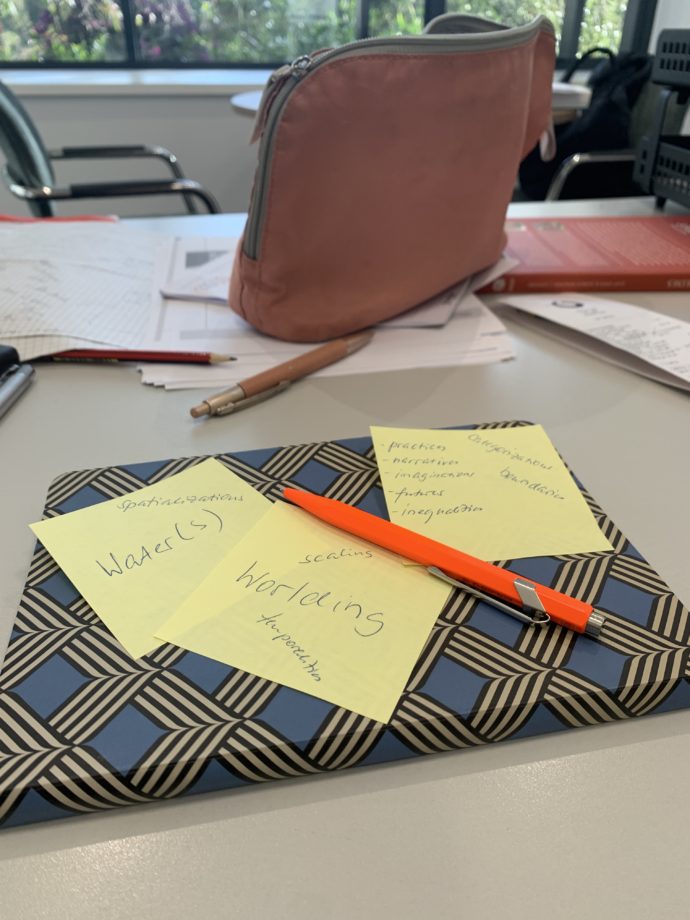
Creation of the text I (I. Dietzsch 2026)
What becomes clear at this point at the latest is that waterworlding is a critical engagement with categorizations, boundaries, spatializations, temporalities, and scaling. In the following, I would like to build on this by offering some ideas for the space of thought and experimentation that this blog can open up:
Let us begin by working on categorisations. When is water what, and how? Which different kinds of water can be identified empirically; which situations can be observed and described as moments of encounter, negotiation or coexistence between such different kinds of water; and what kind of wor(l)ding makes sense in this context? For example, when I speak here of different kinds of water, I do not simply mean different understandings of water but a fundamental recognition of ontologically distinct kinds of water. Is wetness a state of water, or is water a state of wetness – and might not both be true at the same time? Is water alive? Does water have to be physically present in order to be water? When and how is water H2O, what qualities are attributed to it in this context, and which worlds gather around it? A telling example of such questions – which may at first seem highly theoretical but are socially relevant – can be explored in the chapter „What comes after water?” from Jamie Wang’s ethnography of Singapore as a more-than-human city (Wang 2024). In it, she describes the introduction of a new drinking water strategy that relies heavily on desalination. “NEWater”, by now “a dominant mode of water provision” (ibid, 120) is a phenomenon whose feasibility, however, represents less a solution to urban drinking water problems than, above all, a driver for the further growth of water-intensive large-scale industries. “NEWater has been tested as being well within WHO standards for drinking water and accepted as such by Singaporeans”, but “only one percent of it is actually blended into the reservoir as potable water” (ibid, 123). This “technological water”, however, gives rise to a new ontology that radically breaks with notions of water as nature. Wang also refers here to “decoupled water“, “a water imaginary that seeks to separate, extract, and produce water in an eco-modernized sense” (ibid, 120).
When we set out to explore the boundaries of categorisation, questions arise as to where water begins and where it ceases to be water. Can water, in the form of a river, be a person? What about the ontological status of traces, archaeological references or calculations suggesting that water might exist or have existed on other planets? Is water that has been transformed into data still water? Who exercises interpretative power in which context, and what is the point of reference in doing so?
In my own research (Dietzsch 2020), I have described water as a circulating reference (Latour). This concept helps us understand how water remains stable across various transformations during which its material qualities may constantly change. The concept of the circulating reference makes it possible to describe precisely what and who is involved, but also which rules and conditions must be met for this to happen. Whether in paper form, depicted visually as text and tables, or in the form of digital data, water is transformed into “immutable mobiles” (Latour 2009) and thus becomes transportable across vast geographical distances. It circulates through various situations, ontologies or scales, holding things together or letting them go again, bringing together all the actors (hydrological and experiential knowledge, pipes, experts, cables, vessels and storage spaces, technologically generated sensor data, observational data “enhanced” with the aid of technology, data from real-time monitoring, etc.) that its network requires in order to be recognised as water. With its variable materiality, the circulating reference thus also determines its own boundaries of meaning. The reference to water also circulates in digital data worlds, where it encounters and mixes with data from other circulating references (e.g. data on energy consumption, weather data or stock market prices). At this point, another insight from Tsing’s concept of worlding comes into play. She does not confine herself to examining specific practices of creating different worlds but also looks at worlding through “encounters” in which the potentials, limits and partiality inherent in each form of worlding become visible. Thus, in her analytical exploration of worlding exercises, she is seeking points of connection as well as chains of translation (in an ANT sense).
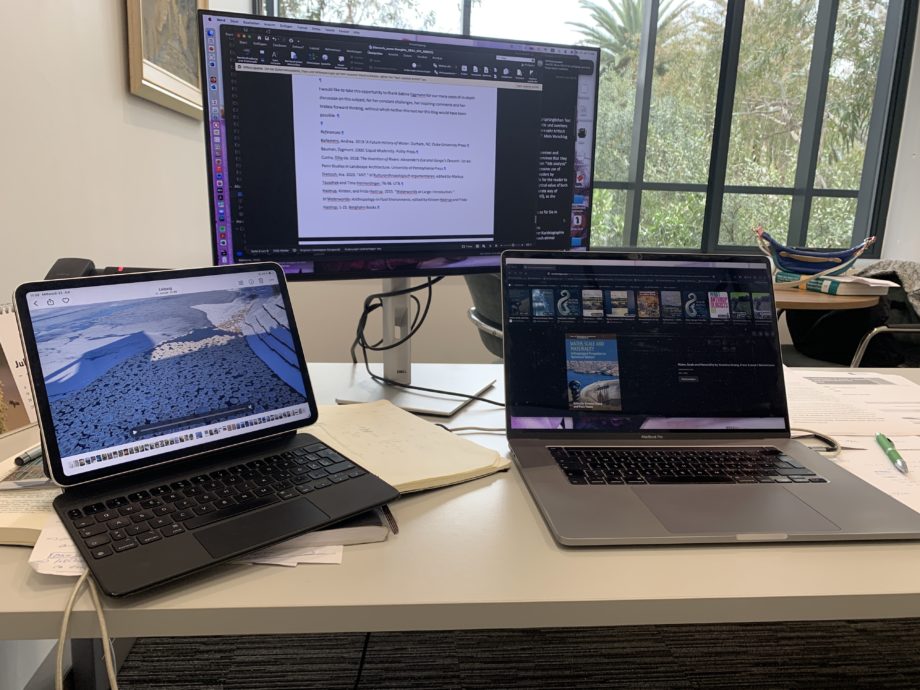
Creation of the text II (I. Dietzsch 2026)
A look at the spatialities of waterworlds leads us to ask a number of more questions: Where can we identify “sites” or “scapes” of interest for ethnographic waterworlding, and in what relations (e.g. waterscapes) are they connected to others? Can we follow the water (Marcus 1995)? Is it a “moving target” (Welz 1988)? Which skills are required of ethnographers in this context? But also: In which spatialisations does water play a decisive role: e.g. rivers, which Dilip da Cunha describes as an expression of ontological violence (da Cunha 2018), or oceans, which have become a method in their own right (Menon et al. 2022)? Or: What are the consequences of thinking in terms of watery bodies or watery beings as opposed to bodies of water?
In her hydrofeminist worlding, Astrida Neimanis constructs an ontology of bodies connected through water, entangled in complex relationships of gifts, theft and debt with other “watery life”:
“Blood, bile, intracellular fluid; a small ocean swallowed, a wild wetland in our gut; rivulets forsaken making their way from our insides to out, from watery womb to watery world: we are bodies of water. […] We are – made mostly of wet matter […] Given the various interconnected and anthropogenically exacerbated water crises that our planet currently faces – from drought and freshwater shortage to wild weather, floods, and chronic contamination – this meaningful mattering of our bodies is also an urgent question of worldly survival. […] I reimagine embodiment from the perspective of our bodies’ wet constitution, as inseparable from these pressing ecological questions.” (Neimanis 2017, 1)
The spatial perspective here is a network dominated by connections, the boundaries of which are of little significance. In this worlding, demarcations and categorisations are politics of retention and flow (Neimanis 2017).
With the discourse on the Anthropocene, time as an analytical category has also come under scrutiny. Instead of speaking of time or age, we now tend to talk about temporalities: When I first heard a “water worker” say, in conversation, that the water we were discussing was very old, I was confused. How does thinking in terms of water cycles – and the common argument that water cannot be used up but can “only” become unusable for humans – fit in with definitions of “old” water? Interestingly, a hydrological experiment at ETH Zurich is currently investigating this by studying water in forest soil. ETH presents the project as follows:
“Over the past five years, soil water samples have been analysed for stable isotopes every week […] which allows conclusions to be drawn about their age, origin and the hydrological processes involved. The result is a unique ‘fingerprint’ of the water. The data confirm what is known amongst hydrologists as the ‘old water paradox’: The soil samples contain mainly ‘old water’ that has been stored in the soil for months or years, and very little new water from recent rainfall. A series of measurements taken between April 2020 and April 2023 shows that even at a depth of ten centimetres, only a third of the stored water is less than three weeks old.”1
Here, water effectively becomes an actor that creates worlds according to their own unique timeline, determining the order in which it appears, where, and how.
Andrea Ballestero has developed a very different temporal horizon through her research in Costa Rica and Brazil. Using the example of the struggles against the commodification of water, she analysed worlding as a structure of successive bifurcations. By bifurcations, she means those moments and practices that shape the future, whereby people, things and ideas are categorically separated from one another and then kept at a distance. In her case, this involves an ethical separation between what is commodified and what is, and should remain, common good. Furthermore, as is evident from the book’s title “A Future History of Water”, this has given rise to interesting temporal arrangements of the past, present and future.
“In place of images of the future, my collaborators hope to create preconditions, forms of structuring future collective responsibility even if that responsibility cannot be allocated juridically, that is, by identifying responsible bodies and establishing causal connections. […] That does not mean, however, that the conditions my informants and their devices help set in place will remain meaningless for a future that has not yet arrived. At that moment, it might turn out that their actions were powerful precursors, activated as new and significant elements of that present. Just as, for example, the statistician that produced the first consumer price index in the nineteenth century did not foresee how inflation would help determine what is a humanitarian price for water, my interlocutors do not claim to secure the consequences of their actions in the future. In this particular philosophy of history, people know that their efforts can be flawed or never fully effective, and yet are necessary. They also know that in the future, the significance of their acts will be recognized differently, not as an instantiation of an image but as one of the preconditions for an unseen one.” (ibid, 190)
And finally, worlding also means scaling. At present, there is constant talk of too much and too little water. But what is the right amount for whom, and at what point in time? What characterises water-rich and water-poor regions when we link this distinction to the concept of relative poverty, which has already been developed in other contexts? In Wang’s work, we find a reference to environmental historian Donald Worster who argues that “the experience of scarcity” is “strongly culturally mediated, if not in fact culturally produced” and in turn “drives the quest to achieve a greater mastery over the natural world” (Wang 2024, 122). When we reflect on scaling in the context of waterworlding, the question also arises as to whether knowledge of water at different scales is even comparable. I am thinking here, for example, of a common situation where the weather app predicts rain but it is not actually raining at that point because the information is calculated rather than measured or experienced. If knowledge on such different scales can nevertheless be meaningfully linked, how are bridges or workarounds built to achieve this, and how are the resulting discontinuities or ontological gaps addressed? Where does hegemonic worlding (for example, with the aid of “big data”) render other forms of worlding (based on embodied everyday practices or indigenous knowledge) invisible or exclude them from perception? This, in turn, leads us to the even more general question of how scales become relevant to waterworlding in the first place, and what meaningful reference point exists for this.
In their introduction to “Water, Scales and Materiality: Anthropological Perspectives on Hydrosocial Relations” (2026), Veronica Strang and Franz Krause suggest that scale should not be fixed as an analytical category but rather be understood as “modes of studying and doing”, “with different conceptual and material scales flowing into each other, and people applying particular (and sometimes multiple) visions of scale according to the context in which they are acting”. This dimension offers yet another connection to Tsing’s understanding of worlding, which I would like to highlight here in conclusion: Her worlding exercises strongly encourage us to reflect on the kind of worlding we ourselves engage in through ethnographic, cultural studies and anthropological knowledge. We are thus explicitly called upon to understand worlding not only as “modes of doing”, but also as “modes of studying”. Therefore, I conclude this introductory post by inviting contributions that consciously heed this call, particularly in our times of crises and transition. This blog sets out to explore waterworlding, as Tsing has put it, as an emergent, non-centralized, cooperative practice and, in the sense of Strang and Krause, as a “mode of studying and doing”, by making experiences, insights, questions and debates available to others by sharing them.
Acknowledgements
I would like to take this opportunity to thank Sabine Eggmann for our many years of in-depth discussion on this subject, for her constant challenges, her inspiring comments and her tireless forward thinking, without which neither this text nor this blog would have been possible.
References
Ballestero, Andrea. 2019. A Future History of Water. Durham, NC: Duke University Press.
Bauman, Zygmunt. 2000. Liquid Modernity. Polity Press.
Cunha, Dilip da. 2018. The Invention of Rivers: Alexander’s Eye and Ganga’s Descent. 1st ed. Penn Studies in Landscape Architecture. University of Pennsylvania Press.
Dietzsch, Ina. 2020. “ANT.” In Kulturanthropologisch argumentieren, edited by Markus Tauschek and Timo Heimerdinger, 76-98. UTB.
Hastrup, Kirsten, and Frida Hastrup. 2015. “Waterworlds at Large: Introduction.” In Waterworlds: Anthropology in Fluid Environments, edited by Kirsten Hastrup and Frida Hastrup, 1-21. Berghahn Books.
Latour, Bruno. 2009. “Die Logistik der Immutable Mobiles.” In Mediengeographie: Theorie – Analyse – Diskussion, edited by Jörg Döring and Tristan Thielmann, 111-144. Transcript.
Marcus, George E. 1995. “Ethnography in/of the World System: The Emergence of Multi-Sited Ethnography.” Annual Review of Anthropology 24: 95-117. https://doi.org/10.1146/annurev.an.24.100195.000523.
Menon, Dilip M., Nishat Zaidi, Simi Malhotra, and Saarah Jappie. 2022. Ocean as Method: Thinking with the Maritime. London: Routledge. https://doi.org/10.4324/9781003279754.
Neimanis, Astrida. 2017. Bodies of Water: Posthuman Feminist Phenomenology. Bloomsbury.
Strang, Veronica, and Franz Krause, eds. 2026. Water, Scale and Materiality: Anthropological Perspectives on Hydrosocial Relations. 1st ed., vol. 36. Berghahn Books. http://www.jstor.org/stable/jj.35079611.
Tsing, Anna. 2010. “Worlding the Matsutake Diaspora: Or, Can Actor-Network Theory Experiment with Holism?” In Experiments in Holism: Theory and Practice in Contemporary Anthropology, edited by Ton Otto and Nils Bubandt, 47-66. Wiley-Blackwell.
Wang, Jamie. 2024. Reimagining the More-than-Human City: Stories from Singapore. MIT Press. https://doi.org/10.7551/mitpress/15189.001.0001.
Welz, Gisela. 1998. “Moving Targets: Feldforschung unter Mobilitätsdruck.” Zeitschrift für Volkskunde 94: 177-194.
Footnotes
1 https://ethz.ch/de/news-und-veranstaltungen/eth-news/news/2025/05/altes-wasser-neue-erkenntnisse.html. In the interest of readability, the quote has been translated from German. Accessed July 15, 2026
Ina Dietzsch is a cultural anthropologist and full professor at the Institute for Critical Studies in Culture and History (EKW) at Marburg University (https://www.uni-marburg.de/en/fb03/eech/research/marburg-water-lab) with research interests in the fields of the anthropology of knowledge, digitisation in everyday life and culture-nature-technology-relations. She holds a PhD from HU Berlin and completed her habilitation at the University of Basel. She has taught at German and Swiss universities and worked in various research projects funded by the German BMBF and DFG, the ESRC and the Swiss National Research Council. She is also a board member of the Marburg Center of Digital Culture and Infrastructure (https://www.uni-marburg.de/en/mcdci) and currently a Fellow at the Stellenbosch Institute of Advanced Studies in South Africa.