














































 | 12/08/26 |
A Thesis on Water
Abstract
If we are to rethink life, then water is the place to begin. / Wenn wir das Leben neu überdenken wollen, dann wäre Wasser die Substanz, mit der wir anfangen sollten.
I am writing this at a moment that many identify as a tipping point, with incremental crises compounding and potentiating each other to such a degree that the consequences become systemic and unstoppable. This is not only the case ecologically, but also socially. The world is already seeing the cascading effects of the geopolitical shifts triggered by the war in Iran. As Watts puts it, the global balance of power is shifting away from a declining petrostate in the West to a rising electrostate in the East; as the world moves “from molecules to electrons”, these shifts are rewriting not only the foundations of politics but also the very nature of human power. Things might get nasty, Watts says. Much depends on the willingness of the proponents of end-times fascism to use their deranged powers to crush the tidal wave toward clean energy autonomy.
But this is only one of the many tectonic shifts that characterize our contemporary polycrisis. The United Nations recently published a report arguing that the world has moved beyond a water crisis and into a state of “global water bankruptcy“ (United Nations 2026). The choice of language is crucial here because the term crisis denotes a temporal structure peaking in ways that allow for resolution or even recovery. The term bankruptcy indicates a state of no return, with “bankrupt or near-bankrupt systems” having irreversibly altered the planet through “insolvency” (ibid.) meaning that water is being withdrawn and polluted beyond renewable inflows and safe depletion limits.
The point of this piece, however, is not to compound an already existing sense of dread. My thesis is instead that water might very well be the substance and protagonist to lead the way at this point of no return, and that it may open up portals through which worlds can be remade. I make this point below by discussing the ways in which water invites us to dwell on questions of space, time, use, and possession.
*
Much is occurring already in the name of the protection of water, all too often via a peculiar form of financialized valuation that has accelerated since the 2008 global financial crisis. Here, all sorts of things (knowledge, housing, personal data, infrastructure, forests, water, whales) can be turned into assets in the name of “sustainability” – investible objects and bankable resources whose value is derived not from immediate commodity values and one-time sales but from the asset’s capacity to generate a stable horizon of future income streams. Anything transformed into an asset can be owned, traded and capitalized with the goal of generating endless returns, also called rent, often for decades to come.
Adrienne Buller analyzes this process beautifully in her description of the International Monetary Fund (IMF) attempting to define the value of a whale. The IMF eventually “settled on an even $2 million per specimen (great whales only), summing to an impressive $1 trillion for the existing global ‘stock’. They based their calculation on whales’ contributions to eco-tourism revenue (ironically detrimental to whale populations themselves) and their robust capacity for carbon sequestration: over their lifetimes, on average, great whales capture the equivalent of 33 tonnes of carbon dioxide – more per pound than a tree. Recognising the potential for this stock, if allowed to return to its pre-whaling population, to sequester 1.7 billion tonnes of CO2 per year, the IMF researchers earnestly suggested investment in whale conservation over other carbon capturing methods. They estimated the cost of such conservation at a modest $13 per person on Earth. $13 – that’s the value of a whale, as it turns out, to you or me” (Buller 2022, 1).
This appraisal of life through the register of investments in stocks is harnessed with green growth capitalism in mind – an economy that is said to offer endless new opportunities for accumulation in the face of the rapid deterioration of the natural world (ibid., 232). In fact, we know that after a certain point, growth only benefits the super-rich (in the past forty years, almost 30% of all new income from global GDP has gone to the top 1% (Hickel 2021, 33-34)). It also cannot be decoupled from environmental destruction. Since 2000, the total growth of material use (that is to say, the global consumption of raw materials) has outpaced GDP growth (ibid., 96); a cannibalization of the living world (Fraser 2022) that hinges on growth for growth’s sake with no endpoint in mind. “We have come to see the world from the perspective of capital,” writes Jason Hickel, “rather than from the perspective of life. Indeed, there is a bitter irony to the fact that we have been persuaded to use the word ‘growth’ to describe what has now become primarily a process of breakdown” (2020: 99).
My thesis is that if we are to rethink life, then water is a place to begin.
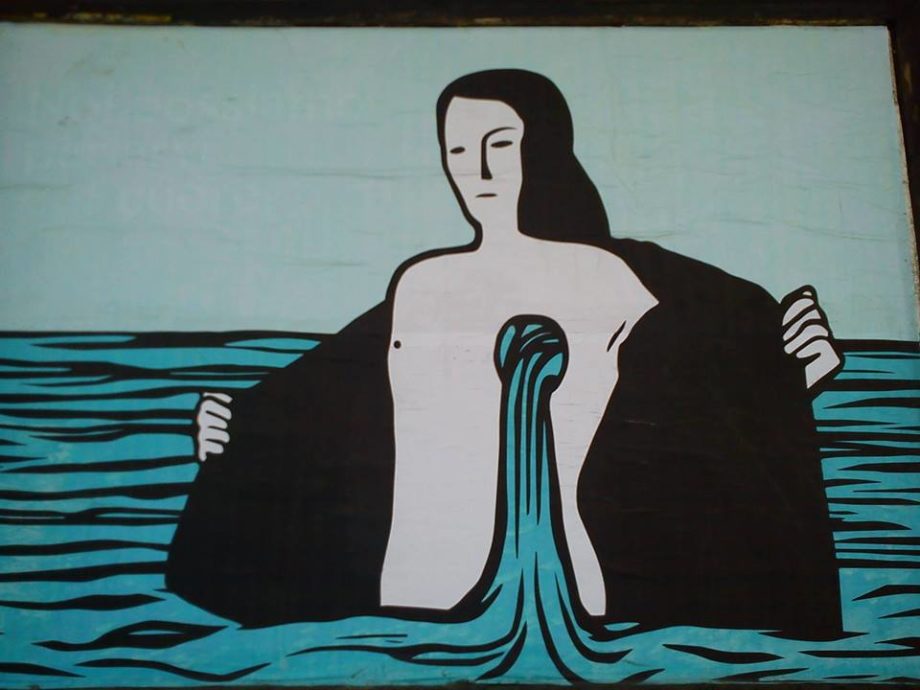
The image evokes the biblical story in John 7:37 where Jesus says to a crowd ” Anyone who is thirsty may come to me. Anyone who believes in me may come and drink. For the Scriptures declare, ‘Rivers of living water will flow from his heart.’” Picture of a poster taken by author in 2013 in Bologna, Italy. Artist unknown.
Water has long posed profound challenges to capitalist incursions into life. Of all the classical Greek elements, water emerges as the element of all elements; the most foundational, abundant, and irreducible of them all. It is water that is so often equated with life and water that is central to all of life´s relations. As Leanne Betasamosake Simpson put it, water allows us to map life and global connection; it “holds a theory of living, organizing, and making worlds beyond the ones we´ve inherited from colonialism and racial capitalism.” (2025)
Because water is everywhere, even in its absence (as in the case of drought), it is always in a “force-filled and ongoing choreography” not only with other elemental worlds, but also with politics and the law (Ballestero 2019; Björkmann 2015; Estes 2024; Hines 2021; Muehlebach 2023; Velásquez 2025). Writing at the early stages of the British Empire, even William Blackstone, the jurist who laid the foundations of English common law and defined private property as the “sole and despotic dominion” of individuals, wrote that water ought to be held in common because it was “a moving, wandering thing, and must of necessity continue to be common by the law of nature so that I can only have a temporary, transient, usufructuary property therein.” (Blackstone 2016) As an unruly substance that constantly circulates through rock, soil, air, and flesh, water troubles the fiction of bodily sovereignty, possessive ownership, and technical mastery (Cattelino 2015; Helmreich 2010; Neimadis 2019; Strang 2022). With qualities that are difficult to measure and temporalities that exceed human comprehension, there is perhaps no other substance that is as out of sync with the legal, political, economic, and material infrastructures humans have built in their attempt to master it. As a limit figure situated uneasily alongside both markets and liberal law, it often escapes from or resides like a fugitive at the edges of enclosure (Kockelman 2016).
Water has long been a charismatic protagonist in political insurgencies all over the world. There is no beginning and no end to these insurgencies since they erupt reliably when water is at stake. Take the beautiful case of the Klamath River, which flows over 250 miles from Southern Oregon to the coast of Northern California and that was choked for over a century with hydroelectric dams. For many years, indigenous peoples living along the Klamath fought to free the river of the dams that kept the salmon from migrating to their ancestral spawning grounds. Today, in the largest dam removal project in U.S. history, the entire Klamath watershed of 420 miles of historic salmon habitat has been fully connected. “It was like witnessing a miracle,” said Yurok lawyer Amy Bowers Cordalis, “watching the moment that the water reconnected for the first time in over a hundred years.” “The river is now free,” as Frankie Myers, the vice-chairman for the Yurok Tribe, put it. The California Department of Fish and Wildlife reported a year after the dams were removed that “the speed at which salmon are repopulating every nook and cranny of suitable habitat upstream … is both remarkable and thrilling.” The pathway of the river had been stitched back together. The “water remembered” (Bowers Cordalis 2025).
Or take the insurgencies that tend to erupt when water is privatized and when the question of water as a human right, commons, or sacred life force is undermined by radical price hikes, shut offs, or prepaid metering. In such cases, water often emerges as a life-giving substance that people insist should be “free”. For example, massive social mobilizations in Ireland between 2015 and 2016 saw thousands of people barricading the entrances to their working-class estates and be surrounded by police as they shouted, “From the river to the sea, Irish water will be free!” When the Irish, like some of my Italian interlocutors who used similar language, insisted that water should run free, they were not naively insisting on nonpayment. What they meant was that water – what people often call “our water” – was a common good that should never be enclosed by private corporations. As a human right, water was to be kept accessible and affordable through a system of cross-subsidization and funded by general taxation.
These calls for water to run free were always accompanied by the call that “water is life,” itself a phrase that circulates globally today but looks back on a specific history. Many of my interlocutors in Europe pointed to Cochabamba, Bolivia, as the foundational moment for their water movements. This was a moment when this conceptual register and its evocative power first came to their attention. The year was 1999, when an international consortium of US, British, and Italian multinationals signed a forty-year concession with the Bolivian government that guaranteed investors a 15 percent annual rate of return. The result was impossible water price hikes that led to the founding of the Coordinadora de defensa del agua y la vida (Committee for the Defence of Water and Life), a mass coalition of unions, indigenous and peasant organizations, ecologist movements, and students that enchanted the political imagination around the world with its protests for water as life. By April of that same year, the Coordinadora had kicked the consortium out of the country (Olivera and Lewis 2004; Bakker 2010; Hines 2021), inspiring tens of thousands as its message cascaded outwards.
There were other insurgencies, too. The Irish, Italian, and German eruptions around water as life occurred between 2000 and 2016 (Muehlebach 2023) and were anticipated over a decade earlier by protests around prepaid water and electricity meters and other political struggles in places such as South Africa and India (von Schnitzler 2013; Björkman 2015). But it was the Standing Rock protests in 2016 and 2017 that became perhaps the most unforgettable forcefield around the call for “water is life” or “Mni Wiconi” in the Lakota language. Here, the people of Standing Rock Reservation tried to stop the construction of a 1,712-mile oil pipeline (the Dakota Access Pipeline or DAPL) that cut across four states—North Dakota, South Dakota, Iowa, and Illinois – and crossed under Mni Sose (the Missouri River) immediately upstream from Standing Rock, threatening the reservation’s water supply and the Standing Rock Sioux Tribe´s sacred lands and cultural resources (Estes 2019, 12). Faced by lines of armed police with attack dogs, tasers, tear gas, rubber bullets, water cannons, and sonic weaponry, thousands of Native Americans and their allies congregated in their Sacred Stone Camp to block the building of the pipeline. As Nick Estes writes, the Lakota and Dakota water protectors were simply being good relatives to the river and honored their relation to it. After all, if a river cannot be owned, “how can she be sold or alienated like a piece of property” (ibid., 21)?
Or take the most recent protests against data centers in the US, which the New York Times described as “the most bipartisan issue since beer”. With data centers being built everywhere to power the AI boom, unusual coalitions have emerged across the country among people who would normally not affiliate – Left, Right, Republican, Democrat. At the time of writing, at least 48 data center projects representing $156 billion in investment were blocked or stalled by local opposition in 2025 alone. As Fortune Magazine reports, more than twenty additional projects were killed in the first quarter of 2026. People have many reasons to block the centers, ranging from higher electricity prices and decreased home values to noise, fear of AI, strained infrastructure, and tax breaks that shift the cost of all of the above onto local residents. But it is water that is once again a central protagonist here. Signs held up during data center protests include “Water for the People, not Billionaires,” “Water for Crops, not AI Slop,” “Save our Water, Save our Future,” and, again, “Water is Life.”
Many of the insurgencies I mentioned above did not end in what we would call clear-cut “victories”. Outcomes were ambiguous, and struggles dragged on despite the exhaustion of the people involved. The recently freed Klamath River is warming due to climate change, leaving the salmon vulnerable to parasite infections. In Bolivia, people continue to struggle over water, with water rationing a possibility by 2030. The poor all over the world continue to struggle for access to water as a basic necessity, and the future of AI centers remains to be seen. Still, water continues to appear repeatedly as the charismatic center of insurgent life. It teaches us much about how the world could be remade.
Here are four axes of this possible remaking: space, time, possession, and use.
The watersheds we grow up in infuse our bodies and leave traces forever. Scientists have determined that humans and the watershed they were born into can be identified thousands of years after their death. Archeologists of the Roman Empire, for example, determine where people were born and raised by analyzing the remains of the carbon isotopes in tooth enamel because human teeth absorb isotopic geological and geographic traces during early childhood and store this information without significant changes throughout life. There is thus a kinship not only between individual bodies and the water they were raised with, but between all other related water bodies as well. Our bodies, in short, are forever marked by the waters we drink – a “chemical kinship” that is sometimes far from benign (Agard-Jones 2013, Neimanis 2017).
This profound intimacy of our bodies with the water bodies that feed us is an intimate iteration of a basic infrastructural reality: In many parts of the world, water is used and managed locally through community-controlled mechanisms (Bakker 2007, 442). In Europe, particularly in Germany, Italy, and Ireland, where I conducted my research, water is primarily managed by municipalities via local water sources and infrastructures (Dukelow 2016; Fantini 2014; Lanz 2005).1 Contrary to the regional and national scales of publicly owned infrastructures such as railroads, telecommunications, and electricity grids, built in Europe and the United States from the 1930s onwards (Collier 2011, 205-206; Bakke 2016), water infrastructures have almost always stayed local. This is partly because water cultures and their attendant infrastructures have always grown out of highly localized histories and developed out of longue durée relations mediated by water (McDonald 2018, 49).
These spatial intimacies come with specific temporalities that differ profoundly from those that organize financial valuation. This was best described by the then head of the Paris water utility Eau de Paris after Paris reverted to public ownership in 2010, ending twenty-five years of private management by Suez and Veolia. Suez had full control over water production and distribution on the left bank of the river Seine, while Veolia had the same responsibilities on the right bank. They said that “from the point of view of the private corporation, your horizon as far as time is concerned is the end of your contract. You’re not incentivized to develop policies for the long term. And if you look at it from the point of view of the challenges that water utilities have to face now, a lot of them are very long-term challenges, like climate change, or the water cycle” (Muehlebach 2023, 170).
As we build new worlds, it is water and its temporalities we need to work from, not the man-made temporalities of private contracts or short-term profits. The question of temporality also loops back to the question of space. Eau de Paris today cares for its commons, its bien commun, from the vantage point of the watershed. This means that it manages the water from the point of view of the entire water catchment area, including the springs, rivers, and aquifers that span Normandy in the north to Burgundy to the southeast. Since its remunicipalization in 2010, Eau de Paris has acquired 153 hectares of agricultural land to preserve environment and water quality through organic farming. The goal is to increase the amount of farmland involved in the project to 40,000 hectares so that the entire catchment area is protected. Apart from the protection of Paris´s bien commun, there are other benefits as well: from protecting biodiversity to sequestering carbon and providing millions of rural landowners with new sources of income. Under the 2027 Sustainable Food Plan, 75 percent of the 30 million meals served each year in the 1,300 municipal restaurants in Paris, including school canteens, must be organic. 50 percent must be produced less than 250 kilometers away. As one farmer put it proudly: “The lentils grown there end up on the plates of Parisian school kids” (Yeung 2024).
We see here that the care for water is not predominantly one of scaling “up,” as some one-worldist planetary proposals suggest. Planetary proposals are, as the authors of a recent article themselves put it, quite “controversial and complex” (Rockström et al. 2024, 7). In contrast to this ambition toward planetarity, we see in Eau de Paris an example of what we might call a lateral “scaling out” – a practice and politics of “hereness” that, according to Naomi Klein and Astra Taylor, is the best path toward countering the life-destroying project of capitalism. To put it in Leanne Betasamosake Simpson’s words, water “asks us to ground ourselves intimately in land and place, and relate that grounding to other movements, geographies, cultures and lands” (2025, 7). This form of dwelling and grounding moves according to ecological and not necessarily political scales and rhythms; it is grounded in the watershed rather than in human-made forms. Eau de Paris acknowledges the many worlds that exist within the substance of water, including landowners, farmers who need to be coaxed into the project, schools that need to begin to buy locally grown food, legal and technical experts, and all others including the land and all other life that depends on water. None of this is an easy process. The management of its bien commun is patiently wrought out of slow, highly localized processes that carefully, and with timescales much longer and across generations, draws together the water and its abundant inhabitants across place, time, and difference.
Water as a moving, wandering thing also teaches us much about use and possession. I like to quote Italian activist and politician Tommaso Fattori, who put it beautifully when he recounted Ovid’s Metamorphosis, a classic of Latin literature written more than two thousand years ago. In it, the goddess Latona asks a group of peasants who refused to allow her to drink from a pool, “Why do you refuse me water? The common use of water is the sacred right of all mankind. Nature allows no one to claim as property the sunshine, the air, or the water. When I drew near, it was a public good I came to share … A draught of water would be nectar to me; it would revive me, and I would find myself indebted to you for life itself” (Fattori 2011).
We often associate indigenous worlds with radical theories and philosophies about the inappropriability of life (Kimmerer 2013, Simpson 2025). But let us not forget that even Europe, the center of colonial and imperial power, also held some of these truths until they were violently suppressed or denigrated and forgotten (Federici 2004). Giorgio Agamben offers us a glimpse of this history through his narration of the eleventh century Fraticelli (Little Brethren) Franciscans, who were part of a group of religious movements that practiced a way of life in which no one claimed ownership of any possession (Agamben 2013, 93). The church considered them heretics because they proposed a new type of order—the common life—and held everything they owned in common. They renounced everything except de facto use itself, since use was necessary for survival and human life. Because the Fraticelli attempted to live outside of regimes of appropriation, ownership, and property, their way of life was thought of as an animal form of life; analogous to the lives of little children (who do not own but only use the property of the father) or madmen “who all lack the disposition to possess” (ibid., 112). In response to these heretical religious movements, the pope established a juridical separation between the Church and its property, and the “minor friar’s” use of books and other moveable property (ibid., 124-125). It was thus a Papal Bull, written by Gregorius IX, that first distinguished between ownership and use, retaining ownership for the pope and the Church while conceding use to the friars. It is from this sharp distinction between ownership and use, made by a pope in the eleventh century, that the first juridically explicit definition of ownership emerged. At this historical moment, the Church articulated a law of ownership in response to Franciscan heresy. “Being proprietary” became a “genuinely distinct sociological type” (ibid., 134). The Catholic Church was thus possibly the first institution that could buy and sell property in its own name. MacPherson, writing about North American settler colonialism, called this sociological type the “possessive individual” (Mac Pherson 2011 [1962]).
All over the planet, water movements theorize and often also practice water in these heretical ways. They see it as something that allows us to think outside of proprietary logics and to ask what a relation to the world as inappropriable would look like. These movements have insisted on a world that could flourish if water were collectively conceptualized around use rather than possession, such as when millions of people in Italy insisted that water as a bene commune – a commons or, when people in Berlin called for “their water”, as a Gemeingut. Of course, commons can exclude as much as they can include, but this exclusion is usually conceptualized as a form of access and care that carefully calibrates access to waters across neighboring communities and generations, not against them (Ostrom 1990). Like poverty or abundance, the commons are not a thing but a relation; they do not exist as static institutions but as processes that are set in motion to negotiate the things humans need to survive on this planet. These movements do not refer to use as a form of usufruct (a legal relationship in which someone may be granted temporary access to a thing while it remains owned by someone else (Empson and Bonilla 2019)). Rather, use is conceptualized as a practice outside of ownership altogether, and as a practice that is always temporary until others, including future generations, will need to use it. Indigenous water protectors are perhaps the clearest and most powerful when they insist that water is a relation and relative, the “first environment” and “first world” that all humans live in, inside the bodies of mothers (Simpson 2025, 64). It is “a matrix of bonds and attachments amongst living things of all kinds, a cascade of living beings across time and space, on a cosmic scale, extending into ancient times and into the future” (ibid., 155-156). As such, it defies the proprietary ethic that dominates many human relationships to the world and decenters the possessive individual which turns the world into a thing to be possessed.
If this is a tipping point, then let us start with water. And let us hope that what today seems like a choked-off crisis will turn out to have been a turning point.
References
Agard-Jones, Vanessa. 2013. “Bodies in the System.” Small Axe: A Caribbean Journal of Criticism 17: 182–92
Bakke, Gretchen. 2016.The Grid: The Fraying Wires between Americans and Our Energy Future. Bloomsbury
Bakker, Sarah. 2010. Privatizing Water: Governance Failure and the World’s Urban Crisis. Cornell University Press
Ballestero, Andrea. 2019. “Aquifers (or, Hydrolithic Elemental Choreographies). Theorizing the Contemporary”. Cultural Anthropology. https://www.culanth.org/fieldsights/aquifers-or-hydrolithic-elemental-choreographies
Björkmann, Lisa. 2015. Pipe Politics, Contested Waters: Embedded Infrastructures of Millennial Mumbai. Duke University Press
Blackstone, William. 2016 [1766]. “Commentaries on the Laws of England”. In Of the Rights of Things. Book II, edited by Stern, S. Oxford University Press
Bowers Cordalis, Amy. 2025. The Water Remembers: My Indigenous Family´s Fight to Save a River and a Way of Life. Little, Brown, and Company
Buller, Adrienne. 2022.The Value of a Whale: On the Illusions of Green Capitalism. Manchester University Press
Cattelino, Jessica R. 2015. “The Cultural Politics of Water in the Everglades and Beyond”, transcript of the Lewis Henry Morgan Lecture given on October 14, 2015. Hau Journal of Ethnographic Theory 5: 235–50
Collier, Stephen. 2011. Post-Soviet Social: Neoliberalism, Social Modernity, Biopolitics. Princeton University Press
Dukelow, Fiona. 2016. “Irish Water Services Reform: Past, Present and Future.” In The Irish Welfare State in the Twenty-First Century. Palgrave Macmillan, 141–165
Estes, Nick. 2024. Our History is the Future: Standing Rock versus the Dakota Access Pipeline. Verso Books
Fantini, Emanuele. 2014. “Catholics in the Making of the Italian Water Movement: A Moral Economy.” Partecipazione e Conflitto: The Open Journal of Sociopolitical Studies. 1: 35–57
Fattori, Tommaso. 2011. “Fluid Democracy: The Italian Water Revolution.” Tansform! Europe.
Federici, Sylvia. 2004. Caliban and the Witch: Women, the Body, and Primitive Accumulation. Autonomedia
Fraser, Nancy. 2023. Cannibal Capitalism. How Our System is Devouring Democracy, Care, and the Planet and What We Can Do About It. Verso Books.
Helmreich, Stefan. 2011. “Nature/Culture/Seawater.” American Anthropologist 113: 132–144. https://doi.org/10.1111/j.1548-1433.2010.01311.x
Hickel, Jason. 2020. Less is More. How Degrowth Capitalism will Save the World. Penguin Random House
Hines, Sarah T. 2021. Water for All: Community, Property, and Revolution in Modern Bolivia. University of California Press
Kimmerer, Robin Wall. 2015. Braiding Sweetgrass: Indigenous Wisdom, Scientific Knowledge, and the Teaching of Plants. Milkweed Editions
Kockelman, Paul. 2016. The Chicken and the Quetzal: Incommensurate Ontologies and Portable Values in Guatemala’s Cloud Forest. Duke University Press
Macpherson, C. B. 2011 [1962]. The Political Theory of Possessive Individualism: Hobbes to Locke. Oxford University Press
McDonald, David. 2018. “Remunicipalization: The Future of Water Services?” Geoforum 91: 47–56
Muehlebach, Andrea. 2023. A Vital Frontier: Water Insurgencies in Europe. Duke University Press
Neimanis, Astrida. 2019. Bodies of Water: Posthuman Feminist Phenomenology. Bloomsbury Academic
Olivera, Oscar and Tom Lewis. 2004. Cochabamba! Water War in Bolivia. South End Press
Ostrom, Elinor. 1990. Governing the Commons. The Evolution of Institutions for Collective Action. Cambridge University Press.
Rockström, Johan et al. 2024. “The planetary commons: a new paradigm for safeguarding Earth-regulating systems in the Anthropocene” PNAS 121 (5) e2301531121
Simpson, Leanne B. 2025. A Theory of Water. Nishnaabe Maps to the Times Ahead. Haymarket Books
Strang, Veronica. 2022. ”Elemental Powers: water beings, nature worship, and long-term trajectories in human-environmental relations” Swedish Journal of Anthropology 4: 15-34 http://urn.kb.se/resolve?urn=urn:nbn:se:uu:diva-463871.
United Nations. 2026. “World enters era of ‘global water bankruptcy’”, UN News: https://news.un.org/en/story/2026/01/1166800
Velásquez, Teresa A. 2025. Pachamama Politics: Campesino Water Defenders and the Anti-Mining Movement in Andean Ecuador. The University of Arizona Press
Von Schnitzler, Antina. 2016. Democracy’s Infrastructure: Techno-Politics and Protest after Apartheid. Princeton University Press
Andrea Muehlebach is Professor of Maritime Anthropology and Cultures of Water at the University of Bremen in Germany. She is the author of “A Vital Frontier: Water Insurgencies in Europe” (2023, Duke UP).