







































 | 04/12/25 |
Whose Health?
Recruiting Vietnamese Nursing Trainees into a German Healthcare Sector in Crisis
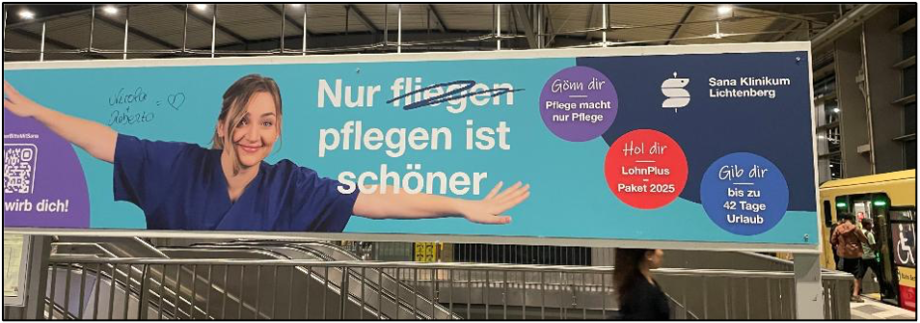
Fig. 1. An advertisement to recruit nursing staff in Berlin. Photo: 2025, EW
Based on a paper presented at the GAA conference in the panel on “Health as a Common Good? Reimagining Health Care in an Unequal World”, I will explore how policy responses to the nursing crisis intersect with broader conceptualizations of healthcare and migration as un/common phenomena. Since recruiting programs for international nurses developed from “recruiting skilled workers from abroad” to “training and breeding talent at home” (Schneider 2023:16), the number of Vietnamese trainees coming to Germany to complete nursing training has been rising constantly. In Berlin, many international classes consist largely of Vietnamese students, yet the curriculum determining their education has not adapted to the international composition of the student body. Language barriers, a lack of understanding of the German healthcare system, bureaucratic hurdles, and dissatisfaction contribute to high dropout rates. In this blog post, I address the question of whose health is considered a common good in current recruitment strategies and migration practices of care labor migrants.
A dilemma forms the starting point for my considerations: the shortage of skilled workers in the care sector, which should have been remedied yesterday by recruiting international skilled workers or trainees. However, this skilled labor migration is managed by an administration that is itself suffering from a shortage of skilled staff and is inadequately prepared for these so-called “increasingly complex cases.” This dilemma, I argue, rests on a definition of care that does not take into account the complexity of migration-driven solutions to the care crisis. It manifests an understanding of care that follows neoliberal principles while neglecting care as a common. It is therefore necessary to critically examine whose health is being taken into account in current recruitment strategies for nursing staff.
I build the argument that current approaches to solving the crisis in the German healthcare sector omit the basal understanding that “in everyday relationships of support, the political, economic, and moral dimensions of care become entangled in one another” (McKearney and Amrith 2021: 1). Scholarship on the anthropology of care states that in contemporary societies, the structures of care and how it is distributed and regulated, are shaped by nation states and economic markets (ibid. 2). Capitalist economies connect care work with the private sector, and recruitment strategies in the global care market rely predominantly on neoliberal principles, a dynamic also actively supported by sending states like Vietnam regarding labor export as a development strategy. Little attention is paid to the impact of migration on health, even though it is recognized as a global public health priority (Castañeda 2022: 363).
Thus, care is not understood as a relational practice involving “processes of creating, sustaining and reproducing bodies, selves and social relationships” (Nguyen u. a. 2017: 202) but rather as a functional term focusing solely on the unidirectional distribution of care. The reproductive labor of developing countries becomes capitalized to address the care deficit in rich countries (ibid. 208). Thus, the international distribution of migrant care labor shapes and reinforces global inequalities (McKearney and Amrith 2021: 5). In this vein, it seems a logical step that the German government hands over responsibility for the recruitment of care trainees from Vietnam to the neoliberal market. As I will demonstrate, this approach is neither economically nor in terms of care oriented towards a common.
I will first draw attention to the intersection of the nursing crisis and international recruitment strategies to grasp the political dimension. Second, I turn to the social dimension, or in other words: Why care for or work in Germany? Third, I examine the economic dimension of the nursing dilemma in terms of ideals, realities, and structural neglect. Finally, I return to my original question: Whose health is considered as part of a common good, and with what consequences for whom?
German nursing crisis meets international recruitment strategies
For two years, I have been researching the migration of nursing staff from Vietnam to Germany. I have spoken and continue to speak with Vietnamese nursing trainees before and after their migration to Berlin, with social workers at nursing schools, with administrative staff, and with various engaged members who work in grassroots organizations and networks promoting the psychosocial health of Vietnamese migrants and developing integrative services for new migrants from Vietnam in Berlin.
What I found was a political economy of healthcare deeply intertwined with the German nursing crisis. Demographic change, an increasing number of people in need of care, and poor working conditions lead to overtime and exhaustion. Low wages, as well as a lack of recognition and appreciation for the nursing profession, result in high job turnover and career dropouts. This directly impacts the quality of patient care.
Hence, recruiting international nursing staff for the healthcare system has become essential due to the severe shortage of skilled workers. Agreements have been signed with many countries in the EU and beyond. In 2019, a cooperation agreement with Vietnam has been signed to recruit trainees for nursing (ZAV 2023, 2). The programs initially aimed at recruiting already qualified nursing staff but have shifted towards bringing people to complete the entire nursing training program in Germany (Schneider 2023: 16). This means that preexisting nursing skills were no longer needed as interested individuals could complete the full nursing training in Germany if they could prove B1-level German profiency. As agreed during those years, private agencies started to recruit and send nursing staff to Germany, thus opening a new market. (Grgic et al. 2019).e
What is the effect of these political efforts? One might assume that these recruitment agreements are based on the understanding that they serve the common good by mitigating the nursing crisis. However, as early as 2019, a policy paper by the Hans Böckler Foundation (ibid.) pointed out structural barriers and missed opportunities because the recruited individuals often leave their jobs: Either they are overwhelmed because they are deployed directly and usually without much training as fully-fledged workers in health care structures characterized by staff shortages. Or, they are underchallenged because certified nurses are denied their professional expertise and are mainly used for physically demanding auxiliary work. Here, the lack of recognition of educational qualifications from the sending country came up repeatedly. Thus, the question prevails what it means to recruit nursing staff without monitoring and adjust the structures within which they arrive and are supposed to work as professionals? Or to put it another way: whose health is taken into account?
Why care for (or work in) Germany?
I come to the second dimension. As briefly mentioned, Germany, like the US, the UK, and Canada before it, has become an attractive destination for nursing staff. Nursing trainees thus become a tool for the common good. In my conversations with Vietnamese nursing trainees, I was told, “Everyone in Vietnam knows about the nursing profession. It is the profession that allows you to go to Germany. Nursing opens doors.”
So, what is the initial situation in Vietnam? During my field research in August and September 2025, I met young people who either knew someone training to be a nurse in Germany or were preparing to do so themselves. Why nursing? Because the placement rate is so good. It quickly became apparent that most individuals were less interested in the nursing profession itself than in working abroad. This has a structural component, as expert on Vietnamese labor migration Mimi Vu writes: “Vietnam has a longstanding remittance culture. This continues to play a significant role in supporting the economies of individual provinces and that of the country as a whole.” (2024: 2) The Vietnamese government actively advocates temporary labor migration as part of their economic development model.
For three decades, the country has experienced rapid economic and technological growth. Within a generation, concerns about poverty and famine have transformed into concerns about the best possible professional future for children, according to psychological anthropologist Allen Tran (2023). Parents locate that future abroad, at least temporarily. While ten years ago, mainly qualified nurses went to Germany, today the majority are high school graduates. Like young people everywhere, young Vietnamese are interested in traveling, living in another country, and meeting new people. This is linked with the fact that many have not yet made a final decision about their career paths. Next to that people with established careers consider temporary labor migration to Germany to achieve upward social mobility. Thus, vocational training is seen as a solid pathway to Europe, which would otherwise be hard to realize due to the limited mobility of the Vietnamese passport (Vu 2024).
However, restrictive entry requirements also have a downside. Businesses take advantage of the fact that those wishing to train abroad are unaware that they could organize their trip to Germany themselves. Bureaucratic barriers legitimize the existence of these intermediaries. The majority of future migrant workers book a complete package. The quality of offers varies immensely, and the market is confusing due to a lack of regulation and constantly changing offers (Hoang et al. 2024).
The pseudonymized case study of Lài, 21 years old, illuminates this opacity:
Going abroad after school was always the plan. Together with her parents, she decided on a career in nursing in Germany, as she would be able to send money from her vocational training soon and she has relatives with temporary working and living experiences in Germany. One year before departure, she moved to a larger Vietnamese city to attend German language classes. Her service agency had arranged it, found a training position for her in a German nursing facility, helped her apply for a Visa, bought her flight tickets, arranged a pickup from the airport, and a place to stay for the next two months. Her parents paid 15.000 Euros for that service; a long-term investment that far exceeds the family’s means. An idealized training plan envisages that trainees leave for Germany with B1 level language proficiency and then have three months to achieve B2 level. Then they start. Theoretical and practical knowledge is taught alternately in nursing school and at the nursing facility.
For Lài, arriving in Germany was different. Her visa was rejected, and she arrived after classes had already started. Two days after her theoretical crash course, she had to go to the nursing facility for the practical part, where she was the only Vietnamese person. Her B1 level proved insufficient for following orders or asking questions. In understaffed wards, the tone is harsh, with little time for instructions. The person responsible for her training often is absent due to changes in the shift schedule.
The social educators stated that the language barrier is the biggest problem making Vietnamese trainees vulnerable to labor exploitation. They noticed that Vietnamese trainees often receive lower salaries than entitled to. They work more than the prescribed working hours. According to the recruitment agreement, they should also be provided with books or laptops by the training providers, which is often not the case. The dropout rate is high. Even more concerning is the number of registered psychosocial stressors among them.
I was told that nursing institutions often dismiss Vietnamese trainees because they are unable to follow classes due to insufficient language skills or are frequently absent. Most of the institutiions were unaware that this was due to bureaucratic requirements. According to nursing staff, trainees are expected to function and “persevere”, yet they must do so in an unfamiliar, inadequately communicated, and dysfunctional system.
Short-term outlook: Many switch to pursue another vocational training or drop out and lose their residence permit. To pay back the migration debt, many work multiple jobs or “live in the shadows” of another identity, working in informal businesses that make them even easier to exploit. Again, I raise the question: whose health is of concern? Why is there no outcry from colleagues, teachers, and administrators about the conditions under which people begin nursing training? Given the structural hurdles they face, their training prospects are bleak, and healthcare provision remains a problem area.
Ideals, realities, and structural neglect
I come to my third point, the economic dimension. Or In other words, the ideals, realities, and structural neglect of skilled labor migration. It has become clear that political efforts on the one hand and personal motives for care migration on the other do not match. This mismatch is being exploited economically by service structures. And all of this hits an ill-prepared administration. Next to the rigid principle of “German as the official language” and the economic exploitation of this void is the ignorance regarding bureaucratic barriers. Registering one’s residence is necessary to open a German bank account. This is crucial for salary payments and proving that the training is ongoing, as residence status is linked to the training contract.
A frequent example: the start of training is delayed due to structural problems as demonstrated above in the case study with the delayed visa issuance. Then the lack of appointments at the local authority to register a place of residence in Germany jeopardizes the success of the politically favored labor migration even before it starts. So, what to do? Fast-track appointments are available from service agencies for a fee. There is a housing shortage, especially in large German cities. So, many live in sublets, which prevents them from registering their residence. Here, too, the known service agencies arrange informal solutions like a “rental contract” that entitles the tenant to official registration. Such an arrangement costs around 80 euros per month, plus dependence on the “landlord,” meaning costs usually grow.
Of course, it would be possible to track how many people are registered as living in an apartment at the citizens’ registration office. Yet, when I asked persons working in administration about this, I was met with a shrug, “yeah, but what can we do about it?” Nothing happens because the responsibilities are unclear. Relying on data from a pre-study (Hoang et al. 2024), an environment of neglect is possible because of a lack of guidance and staff shortages. One interlocutor working in administration summed it up: “Shortages are being managed on all sides. And we are right in the middle of it.” There is no supervisory authority to monitor the recruitment and arrival of Vietnamese nursing trainees. Experts criticize the few partnerships between German federal agencies. It seems, political authorities have withdrawn from controlling and monitoring this “politically important migration.”
Whose health?
Examining the recruitment of Vietnamese nurses amidst Germany’s nursing crisis critically questions who is included in healthcare as a common good. Instead, tensions between commodified labor practices and the collective aspirations of equitable and accessible health systems reveal how contested and fragmented healthcare is.
Despite numerous signed recruitment agreements, there is no sign of long-term relief for the nursing system, as structural barriers make it difficult for migrant nursing staff to remain in training. For colleagues in nursing, an unregulated and unmonitored recruitment structure means additional work. A lack of recognition that integrating and training international nursing trainees in the German healthcare system requires resources disregards the realities of a nursing sector suffering from shortages. The inconsistency in the personnel structure leads to unreliability and ultimately to unsatisfactory relief, which manifests itself in discriminatory practices. For patients, changing contact persons can, in the worst case, mean lower quality care with negative effects on their health. For nursing schools, a lack of integration of the realities resulting from labor migration of nursing trainees means that targeted training is repeatedly interrupted by linguistic and cultural differences. For trainees, this leads to pressure from all sides and blame for something that has systemic roots. The dysfunctional structure of the care labor migration all too often leads to them not achieving their goal of completing their training. While the structural level of this problem is concealed, the blame, migration debt, and often feelings of shame weigh heavily on their shoulders. This is an issue that is currently receiving a lot of attention in the media and exacerbating the situation, as everyday incidents of discrimination and anti-Asian racism are on the rise. The current calculation of the healthcare industry fails to take into account the fundamental emotional and affective dynamics of migration itself, and care labor migration in particular: there is no consistent structure in place to support the recruited nursing trainees upon their arrival, enabling them to fulfill the purpose of their migration. And this has to do with the market-driven recruitment strategies and the neoliberal and unidirectional understanding of care on which the current care labor migration is based. Of course, there are also positive examples. But these are again structurally burdened by the fact that they can apply for a seal of approval for fair recruitment conditions. In fact, however, this could also be done in advance by a state regulatory authority for quality assurance purposes.
Summing up, we must critically ask how far migration-driven solutions to the nursing crisis can be fair when structural problems in the German healthcare sector prevail. Currently, shady service agencies profit from the absence of regulations and a lack of cooperation from local authorities. What is needed is a change in attitude based on viewing health as a common good and as a reciprocal practice. Simple first steps toward relief could include providing housing and recognizing that language acquisition must be an integral part of the training program for international nursing trainees. After all, this is not new knowledge as important lessons could be learned from previous experiences of labor migration.
References
Castañeda, Heide. 2022. „Anthropological Approaches to Migration and Health“. In A Companion to Medical Anthropology. https://doi.org/10.1002/9781119718963.ch13.
Grgic, Mariana, Christa Larsen, Sigrid Rand, Birgit Riedel, und Dorothea Voss. 2019. Vertane Chancen in der Fachkräftebindung in der Pflege. Strukturelle Hindernisse bei der Integration von migrierten und quereinsteigenden Fachkräften. Forschungsförderung Policy Brief Nr. 005. Hans-Böckler-Stiftung.
McKearney, Patrick, und Megha Amrith. 2021. „Care“. In The Cambridge Encyclopedia of Anthropology. The Open Encyclopedia of Anthropology. https://www.anthroencyclopedia.com/entry/care.
Nguyen, Minh T. N., Roberta Zavoretti, und Joan Tronto. 2017. „Beyond the Global Care Chain: Boundaries, Institutions and Ethics of Care“. Ethics and Social Welfare 11 (3): 199–212. https://doi.org/10.1080/17496535.2017.1300308.
Schneider, Jan. 2023. Labor migration schemes, pilot partnerships, and skills mobility initiatives in Germany. Background Paper to the World Development Report 2023: Migrants, Refugees, and Societies. Working Paper. SVR (Sachverständigenrat für Integration und Migration/Expert Council on Integration and Migration).
Vu, Mimi. 2024. Analysis on Labour Migration from Vietnam to Germany: Protecting Vulnerable und Unskilled Groups. Friedrich-Ebert-Stiftung Vietnam Office.
ZAV. 2023. „Projekt Auszubildende Triple Win aus Vietnam“. Bundesagentur für Arbeit, Zentrale Auslands- und Fachvermittlung.
Edda Willamowski received her doctorate at Freie Universität Berlin and is currently a postdoctoral researcher and lecturer at Martin-Luther-University Halle-Wittenberg. Her research interests encompass (forced) mobility, affects and emotions, as well as silence and care(work) in transnational lifeworlds between Germany, Vietnam, and the USA. Focusing on healthcare inequities, her work examines patterns of care labor migration in the context of the nursing crisis.