














































 | 29/07/26 |
Anthropology. Activism. Power. Celebrating 10 years of boasblogs
Conference at the ICI Berlin Institute for Cultural Inquiry on October 16, 2026
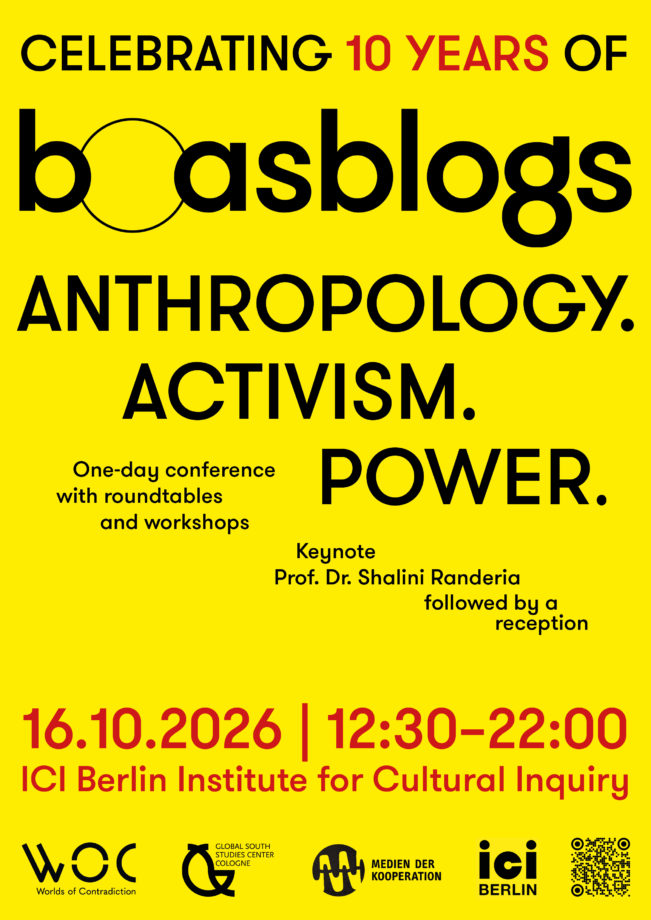
Keynote by Prof. Dr. Shalini Randeria (U Bremen Excellence Chair Worlds of Contradiction): A Politics of Hope against Soft Authoritarianism
To attend in person, please register here.
boasblogs is a series of topic-related blogs that take up current issues related to anthropology, discuss them in their controversiality, and ask about the public role and social impact of anthropological knowledge. All boasblogs, as public anthropology, aim to make scientific findings accessible to a broader public in order to make a critical-constructive contribution to contemporary social and political debates. boasblogs share anthropological knowledge with non-academic audiences in the broadest possible way but also see themselves as a space for intra-academic learning at the intersection of research and teaching. As a result, boasblogs have become an interdisciplinary, intergenerational, and increasingly international forum with numerous editorial teams and a diverse group of currently more than 550 authors, bringing together different institutions and perspectives and inviting readers to take the liberty of adding nuance to established conversations, raising objections or proposing their own topics.
At this conference, to celebrate our tenth anniversary, we focus on three current topics that assess the relation between anthropology, activism, and power in Germany and beyond. These topics will be introduced in individual boasblogs published in the run-up to the conference and will then be discussed during the conference in roundtables and interactive workshop formats.
The conference addresses a broad audience interested in the social and political relevance of anthropological research and perspectives and we look forward to the attendance of past and future authors as well as members of the institutions in Bremen, Cologne, and Siegen that generously fund boasblogs.
Introduction | Between Public Anthropology and Anthropology in Public: 10 Years of boasblogs
Michi Knecht, Ferdiansyah Thajib, Ehler Voss & Martin Zillinger
Panel 1 | Roundtable | Ethnographing Germany?
Ethnographically generated knowledge makes social processes visible and actively shapes them. Yet in Germany, its public reach often remains limited. This roundtable panel presents scholars working in the anthropology(ies) of the present to reflect on their own ethnographic research in Germany and its societal contribution. The roundtable aims to discuss what ethnographic research can teach us about contemporary social processes and how this work can contribute to ongoing debates, both within academia and in the public sphere. Anthropologists conducting research in Europe, in particular, often navigate the tension of being closely embedded in the “field” while simultaneously being part of the very social contexts they seek to study. In this panel we want to place these experiences at the center of the discussion. Thus the panel focuses on ethnographic research conducted in and about Germany and discusses relevant questions for a current public anthropology: How does anthropological research contribute to our understanding of contemporary social processes in Germany and beyond? What insights emerge through ethnographic fieldwork? And how can these insights be brought into ongoing societal debates?
Participants: Simone Egger (Saarbrücken), Janine Hauer (Halle), Desirée Hetzel (München), Felix Ringel (Durham) & Julia Vorhölter (Hamburg)
Panel 2 | Live Commentary | Beyond Activism
In this panel, we will examine the widespread science and activism-dichotomy and aim to challenge the distinction between activist and non-activist science that is repeatedly made within anthropology as well as other disciplines, and that usually evokes the possibility that knowledge practices with an agenda can be distinguished from knowledge practices without an agenda.
We will thus focus on the topic of “activist science” and “scholar-activism”, and invite a debate that addresses questions such as the following: Who calls whom an “activist” and for what reason? What epistemological and ethical assumptions are implicit in such a decision? How are the opposites of, or alternatives to, activist research conceptualized? Is such a distinction even possible? And what are the consequences of such conceptions for anthropological research and teaching?
In his Theses on Feuerbach Karl Marx wrote the famous sentence that the philosophers have only interpreted the world in various ways; the point, however, was to change it. Vijay Prashad offers a twist with the quip that it would be impossible to know anything about the world without wanting to change it in some way. So now we would like to raise the question: Those who want to understand the world without wanting to change it: what do they claim to do?
For each contribution, pre-selected quotes are displayed. Participants have the opportunity to comment on these quotes through a digital platform. After the comments are posted, an open discussion takes place in which authors and participants engage directly with each other.
Present authors: Judith Albrecht (Vienna), Alisha M.B. Heinemann (Bremen), Markus Höhne (Göttingen)
Discussants: Viola Castellano (Berlin), Katharina Schramm (Berlin), Helena Zohdi (Frankfurt)
Moderation: Mihir Sharma (Bremen)
Panel 3 | Multimodal | Power Struggles: Academia
This panel addresses recurring patterns in academic life that many experience but few can openly name: how power within academia is structured unevenly, opaquely, and often elides accountability. It shapes careers, produces legitimacy, and determines who is heard, cited, hired, promoted, or quietly pushed out.
Selection procedures for professorships that are formally transparent yet ethically opaque, hiring practices that often depend on informal endorsements rather than explicit criteria, and tightly knit networks that reproduce themselves under the guise of meritocracy, all point to these enduring conditions. In the German context, these dynamics are further shaped by the WissZeitVG, which produces structurally precarious career trajectories, and by the highly concentrated power and resources embedded in professorship appointment procedures. They are not simply matters of institutional framework but constitutive of the university’s ongoing neoliberal transformation, where intensified managerial regimes reorganise academic life and recast what counts as knowledge and who is authorised to produce it.
In practice, academic trajectories are rarely determined by formal criteria alone; they are also shaped by lineage, patronage, and alignment with established networks. Processes of evaluation, such as job interviews, grant reviews, and promotions, feel hard to predict, as they also involve dynamics of recognition, affective economies, and situated judgment. Under these conditions, belonging remains contingent while exclusion is routinely produced in ways that are systemic yet hard to articulate, sustained through subtle practices of censorship and self-censorship.
This panel will not only unpack these dynamics but also propose actionable points for redress. What forms of refusal, solidarity, or intervention are possible within and against these structures? How might accountability be meaningfully enacted, and how might academic life be organised otherwise? The panel will work through these questions collectively, using embodied and sensorial activities alongside discussion.
Participants: Julia Baumann (Münster), Andrea Fleschenberg (Berlin), Annika König (Berlin), Smitha Muttanoly (Berlin), Thomas Stodulka (Münster) & Ferdiansyah Thajib (Erlangen-Nürnberg)
Keynote | Shalini Randeria: A Politics of Hope against Soft Authoritarianism
The talk focuses on the concept of soft authoritarianism to highlight the blurring of the distinction between democracies and autocracies as formally democratic means (parliamentary majorities, laws, regulations) are being increasingly used to further illiberal authoritarian ends in polities across the world. Delineating the contradictory logics of soft authoritarian discourses and practices, the talk explores their affective aspect too. It argues that repressive reproductive policies coupled with a majoritarian demographic imagination characterize this kind of rule that fuels resentment and an exclusionary politics. Academic freedom and university autonomy are also casualties of soft authoritarianism as evident in Hungary or the USA. However, the talk ends on an optimistic note by offering a preliminary analysis of student movements that have successfully ended soft authoritarian rule in Sri Lanka, Bangladesh and Nepal, where they now strive to sustain the momentum for fundamental change.
Shalini Randeria is Rector Emerita, Central European University (CEU), Vienna and deputy chair of the Class of Social and Related Sciences, Academia Europaea. She holds the Excellence Chair Worlds of Contradiction (WOC) at the University of Bremen. She has published widely in English and German on soft authoritarianism and academic freedom; globalization of law, state, and policy; reproduction and gender; civil society and social movements; processes of juridification and justice-seeking by ordinary citizens as well as post-colonial theory. Among her recent publications are the edited volumes and special issues: Soft Authoritarianism, Special Issue of Global Society (in press); Kapitalismus im 21. Jahrhundert (2021); Forum on Seed Activism: Journal of Peasant Studies (2020); Social Science at the Crossroads (2019); Wenn Demokratien demokratisch untergehen (2019). Her podcast “Democracy in Question” with over 120 episodes is in its 12th season.
Schedule
12:30 Arrival
13:oo–13:15 Introduction
13:15–14:30 Panel 1 | Ethnographing Germany?
14:30–15:00 Break
15:00–16:15 Panel 2 | Beyond Activism
16:15–16:45 Break
16:45–18:00 Panel 3 | Power Struggles in Academia
18:00–18:30 Break
18:30–20:00 Keynote | Shalini Randeria: A Politics of Hope against Soft Authoritarianism
20:00–22:00 Reception
Organizers
Franziska Fay (U Mainz), Ferdiansyah Thajib (U Erlangen-Nürnberg), Ehler Voss (U Bremen), and Martin Zillinger (U Cologne)
Contact
Franziska Fay <franzifa@uni-mainz.de>
Ferdiansyah Thajib <ferdi.thajib@fau.de>
Ehler Voss <ehler.voss@uni-bremen.de>
Martin Zillinger <martin.zillinger@uni-koeln.de>
Website
Funding Institutions
The conference will be funded by the interdisciplinary and collaborative research platform Worlds of Contradiction (WOC) at the University of Bremen, the Collaborative Research Center (CRC) Media of Cooperation at the University of Siegen, the Global South Studies Center (GSSC) at the University of Cologne, and the ICI Berlin Institute for Cultural Inquiry.