












































 | 13/10/26 |
Who Cares When Academia Doesn’t?
The Hidden Infrastructures of Care and Academic Kinship within academic cultures of no-feeling

Fig. 1 The visible academic and the hidden infrastructures that sustain them. Drawing by the author, 2026 Copyright: Julia Baumann.
Abstract
The article asks: Who cares when academia doesn’t? Who makes ethnographic knowledge production possible, and what becomes visible when we look beyond “the other” in the field to those sustaining researchers at home? At the same time, care is unequally distributed and can itself reproduce burdens and inequalities. Recognising these hidden infrastructures therefore means questioning what counts as academic work and whose labour makes knowledge possible. Academic institutions increasingly leave the emotional and relational costs of academic work to individuals. When institutional structures fail to provide adequate forms of care, these costs are absorbed by relationships beyond formal academic infrastructures. This article examines these often invisible relationships as hidden infrastructures of care: friends, partners, family members, colleagues, and peers who sustain academics through the emotional and practical demands of their work. I argue that these infrastructures are not merely private support networks but are constitutive of academic knowledge production. They enable researchers to experience, process, and survive the encounters through which ethnographic knowledge emerges, while remaining largely invisible within academic accounts of labour and achievement.
“How are you doing?”
This is a seemingly simple question. In academic life, however, the answer is rarely as simple as the question suggests. In professional work environments, where emotions are seen as incompatible with professional, rational work, the chances of getting an honest answer to this question are rare.
When I began my ethnographic research, I was interested in the emotional worlds of researchers: fear, distress, exhaustion, anger, but also enthusiasm, attachment, and care and I encountered a striking contradiction: Academia was anything but emotionless. Academic life is saturated with fear, excitement, shame, exhaustion, ambition, affection, disappointment, resentment, joy, and sometimes rage. Yet emotions were often treated as something that should be managed, contained, or kept separate from “professional” academic work. This became the starting point for what I call academic cultures of no-feeling (Baumann 2022: 375–394; after Bloch 2012: 140). These are not cultures without emotions, but cultures in which emotions are selectively recognised, regulated, and concealed. I began to wonder: what happens to those feelings when they enter an institution that expects them to remain professionally invisible?
In this blog pst I draw on my ethnographic fieldwork conducted between 2019 and 2023 among ethnographers at German universities, including more than fifty in-depth conversations and narrative interviews, next participant observations. The participants represented diverse academic positions, career stages, genders, social backgrounds, and research fields, while fieldnotes also captured gestures, silences, bodily expressions, and shifts in atmosphere that could not be fully conveyed through words alone.
When institutions manage distress instead of its conditions
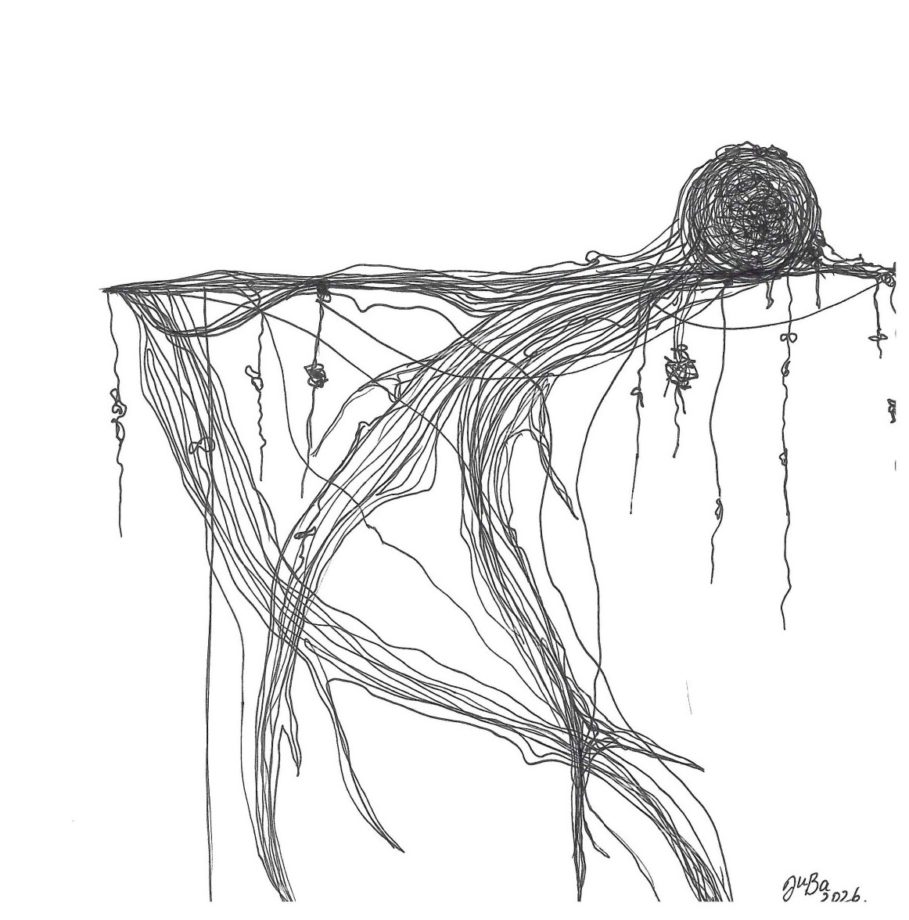
Fig. 2 Held by a web of relations: academic life between mobility, precarity, and care. Drawing by the author 2026 Copyright: Julia Baumann.
In these systems, ethnographers are not simply passive: they actively negotiate their emotions and form affective communities (Baumann 2022). Yet many of my interlocutors also described feeling overwhelmed, helpless, and constrained by a system that does not allow them to feel, and by emotions they themselves cannot simply switch off. They expressed particular disappointment with academic institutions that, in their experience, offered little support.
This matters because emotional norms are never neutral. The ability to remain calm, detached, and self-controlled is not distributed equally. Existing inequalities (of gender, race, class, status, disability, sexuality, and institutional position) shape whose emotions are interpreted as legitimate and whose are dismissed as excessive, subjective, or unprofessional. I call this affective inequality: an uneven distribution not simply of resources or recognition, but of the right to feel and express particular emotions.
In my research on the institutional handling of mental and emotional distress I discovered that universities have increasingly learned to address distress without necessarily transforming the conditions producing it (Baumann 2025: II/11–23): if you are overwhelmed, you might be offered resilience training; if you are anxious, counselling; if you are exhausted, mindfulness. I encountered a similar dynamic in situations of academic power abuse. Interviewees described fear, shame, sadness, anger, and intense distress in situations of hierarchical dependency and boundary violations (Baumann 2023).
But what happens when the system itself is the problem? Or precarity, discrimination, dependency, or a culture in which excessive work becomes a sign of commitment (Liu 2026)?
Cultures of no-feeling can thus create a vicious circle: power relations produce distress; self-regulation makes the structural problem less visible; and institutions continue to treat the consequences as individual difficulties. If overwork requires meditation, perhaps the workload is no longer the problem. If precarity requires resilience, perhaps precarity is no longer the problem. If discrimination requires emotional self-management, perhaps discrimination is no longer the problem.
A structural contradiction becomes an individual emotional problem—and the individual is expected to solve it.
But who cares then? The hidden infrastructures of care
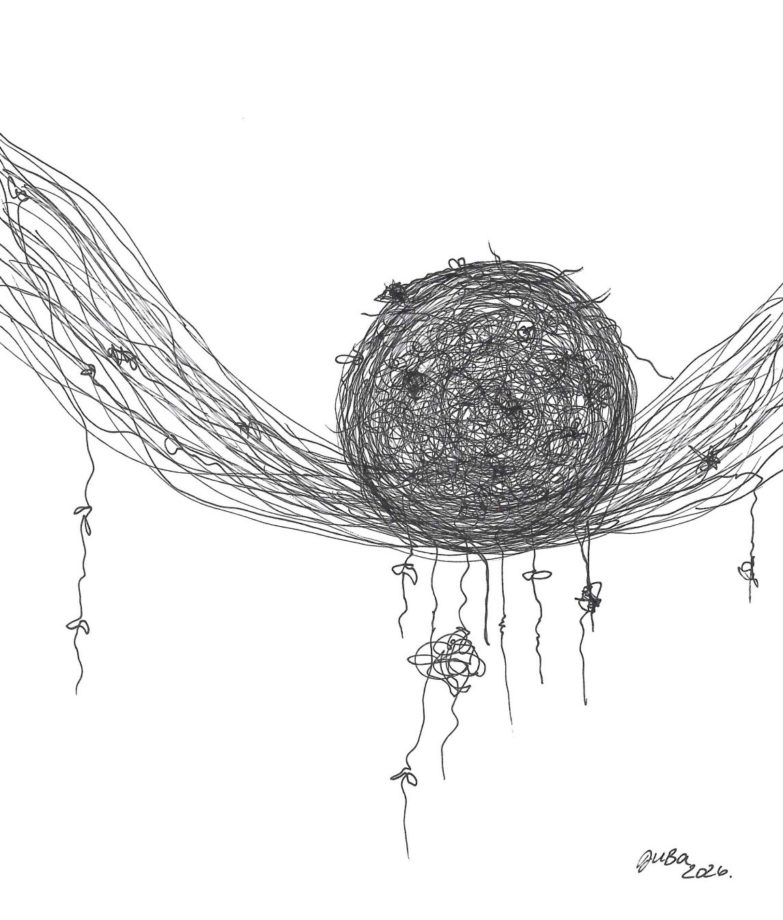
Fig. 3 Hidden infrastructures of care: held, connected, and entangled. Drawing by the author, 2026, Copyright: Julia Baumann.
But who takes care of people’s feelings if not the institutions? In my experience, individuals are often overwhelmed by this task. To create a framework not only in one’s own work but also to maintain a space for one’s feelings (one that isn’t merely an “echo chamber” of self-absorption) requires an almost superhuman effort.
Pulling oneself out of this predicament by one’s own bootstraps remains an impossibility even in a neoliberal and structurally individualistic culture like Germany’s. Yet obtaining professional help is often just as difficult within Germany’s current healthcare system. It costs time, money, and a tremendous amount of willpower. Often, it is simply impossible to find: The average waiting time for a publicly funded psychotherapy slot in Germany is about 5 months. In heavily populated regions or those with less developed infrastructure, such as rural areas, it is significantly longer. About forty percent quit their therapy prematurely.
So who actually holds the emotional consequences of academic life? Who holds this space and often maintains it for years until a project is completed? The answer from my field is: other people. Friends. Partners. Family members. Colleagues. Peers.
A colleague who stays after a difficult meeting. A friend who listens when you cannot tell your supervisor what happened. A partner who absorbs another evening of academic anxiety and instability. A family member who helps out when a contract ends. A supervisor who makes vulnerability possible without immediately turning it into a professional liability. Colleagues who share knowledge, food, contacts, childcare, a place to sleep, or simply time to talk. A cohort that becomes a community.
Sometimes someone who simply says: No, this is not just happening to you.
These relationships are easy to overlook because they do not usually appear as part of academic work. But perhaps this is precisely the problem: Recent research on academic carework makes this visible: Dasgupta, Peat, and Vogelaar demonstrate that academic care labour is not peripheral additions to academic work but increasingly embedded within it, but remains largely invisible and unaccounted for (2024: 170–195). Institutional accommodations often treat care as an exceptional, temporary, individual problem rather than as an ongoing and relational condition of human life. The result is that individuals are expected to accommodate themselves to institutions, rather than institutions being transformed around the realities of interdependence (Greer et al. 2024: 660–662).
I therefore propose thinking of these relationships as hidden infrastructures of care (after Li and Laughlin 2024: 2513–15): infrastructures constructed around, underneath, and sometimes in spite of the university. These relationships do not merely make academic life more pleasant. They are what makes knowledge production possible in the first place.
And what about the people who care?
Once we start looking for hidden infrastructures of care, we also have to ask who performs this work. That is exactly where the problem lies. As the description makes clear, this work takes place behind the scenes. As is often noted in discussions of care work, it is rarely viewed as work, but simply as “normal.” Care is not evenly distributed (Lynch et al. 2009: 12–34). Greer et al. show that academic carework is deeply shaped by gender, race, class, sexuality, age, and academic precarity (2024: 658–661). They also caution against romanticising care: relations of care can themselves reproduce inequalities, and the people who provide care may become further burdened by it (2024: 663–665). As my research on distress and academic power abuse has shown, academic experiences can be deeply unsettling and sometimes profoundly hurtful (Baumann 2023; 2025). Caring for someone who is severely psychologically distressed can itself be emotionally and psychologically demanding. Research on informal caregivers documents substantial emotional burden, social isolation, and the neglect of caregivers’ own needs, while support structures often remain inadequate (Lynch et al. 2009: 12–34¸Jacobsen, Nørgaard, and Marcussen 2026: 277–288; Yesufu-Udechuku et al. 2015: 231–238). The hidden infrastructure of academia is therefore also an unequal infrastructure. Having someone offering support to you is in itself a privileged situation that should not be taken for granted.
Care is not a private solution to a public problem
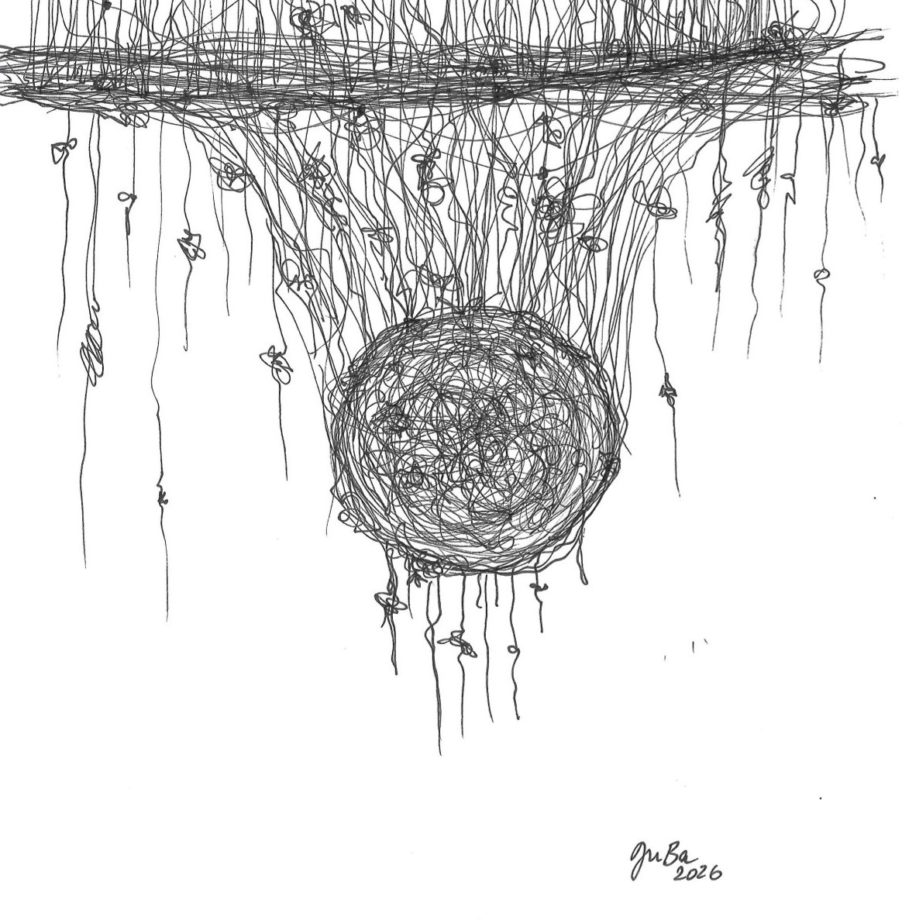
Fig. 4 Who holds whom? Care as support, dependency, and entanglement. Drawing by the author, 2026., Copyright: Julia Baumann.
Infrastructures are often most visible precisely when they break down.
As Fraser makes clear, systems of production depend upon care while simultaneously placing pressure on the very social relations and capacities through which care is provided (2016: 99–103, 111–117): Universities depend upon people who are emotionally and socially capable of continuing to work. Yet the institutional organisation of academic work can simultaneously undermine the relationships, time, security, and resources through which people are sustained.
In my fieldwork, several interviewees described massive sacrifices in their personal lives: “sacrifices that simply have to be made for a career in academia.” One major issue was mobility, expected above all from early-career academics. With few positions available, people search across Europe; for social and cultural anthropologists, a global search is often expected, alongside regular fieldwork abroad. Constant moves and fixed-term contracts were repeatedly presented to those affected as something “positive”: after all, it’s nice to see new places and gain new experiences. Yet mobility becomes a burden when it is economically forced. Precarious, non-continuous contracts meant that, in my study, it was almost normal to write a dissertation while living on welfare. Interviewees spoke of broken relationships and friendships, and of never truly settling anywhere.
Many lived permanently out of their suitcases (“you’ll be gone again soon anyway”) in sublets or on acquaintances’ couches. Some saw certain life plans as simply incompatible with an academic career. As one interviewee told me: “I’ve actually always wanted a stable relationship and a child. But with all this nomadic lifestyle and the lack of money… and then as a woman in academia, I don’t think that’s really possible these days […]. So I had to make a choice, and I chose academia.”. Perhaps this also helps explain why I observed that many relationships, marriages, and close friendships were among ethnographers themselves. “I kind of have the feeling that it only works that way. You don’t have to explain much. They know right away what it’s all about if they’re also in academia […], so they don’t expect you to be around all the time,” another acquaintance explained.
Who does the work?
Care has become an essential component of academic work but it remains largely invisible, unaccounted for, and unequally distributed (Dasgupta/Peat/Vogelaar 2024: 170–195; Greene 2026: 57–60). It becomes a private buffer against institutional instability. And this is not sustainable.
Feminist scholarship has long challenged the idea that productive work can be understood independently from the work required to reproduce the people who perform it. Nancy Fraser argues that productive economies depend upon the unpaid and often invisible work of maintaining people, relationships, and communities, even though this work is treated as external to production (2016: 99–103). Historian Nina Verheyen similarly challenges the idea of individual achievement: what appears as an individual accomplishment always depends on social conditions, relationships, and forms of recognition that disappear when achievement is attributed to one person (2018: 11–12, 199–206). The same is true of academia.
This perspective opens up an uncomfortable question for academia: Who does the work? What appears as my publication, my dissertation, my grant, or my career is always also the outcome of a much larger social constellation. The academic CV turns this collective process into individual achievement. In this sense, the “autonomous academic” is not simply a myth of meritocracy. It is a social achievement in itself—one that depends upon forms of support and care that rarely appear on the CV.
So, who cares when academia doesn’t?
The answer is: very often, other people do. They make academic lives possible in ways that rarely appear in CVs, performance evaluations, funding applications, publication lists, or university statistics.
Ethnographic knowledge is produced through encounters with others: through trust, discomfort, vulnerability, embodiment, interpretation, and affect. “The other” usually refers to the ethnographic subject, conversation partners, gatekeepers, and fieldwork encounters. But about these fundamental hidden infrastructures of care “at home? If ethnographic knowledge emerges through trust, vulnerability, embodiment, interpretation, and affect (Lutz and White 1986: 405–436), then perhaps we need to look beyond the encounter with “the other” and ask what happens at home. Who makes it possible for researchers to experience, process, and survive these encounters? Who absorbs the emotional and practical costs of academic life?
Care may therefore not simply sustain academic workers. It may sustain some of the conditions under which academic knowledge can be produced at all. Recognising these hidden infrastructures of care cannot mean celebrating private networks as safety nets for institutional failure. We owe these people more than our social appreciation. We owe them an academia that recognises its dependence on care and takes responsibility for the conditions under which care can be given without being privately exploited. Perhaps we even owe these relationships a place in our methodological reflections: if they help make academic knowledge possible, should they not also become part of how we understand and account for its production?
References
Baumann, Julia Nina. 2022. “The Ethnographers’ Fear to Feel: Manoeuvring through an Affective Community of No-Feeling within the Academe.” Emotions and Society 4 (3): 375–394. https://doi.org/10.1332/263169021X16632021773516.
Baumann, Julia Nina. 2025. “Academies of Silence: The Institutional Dealing with Mental and Emotional Distress before and after the Pandemic in Germany.” In Radical Health, II/11–II/23. Zürich: intercom Verlag.
Baumann, Julia Nina. 2023. “Contesting Academic Cultures of Power Abuse.” Contested Knowledge, BOASblogs, July 11, 2023.
Bloch, Charlotte. 2012. Passion and Paranoia: Emotions and the Culture of Emotion in Academia. Farnham: Ashgate.
Dasgupta, Poulomi, Alexandra Peat, and Alison E. Vogelaar. 2024. “Care in the Time of COVID-19: Accounting for Academic Care Labor.” Journal of Economic Issues 58 (1): 170–195. https://doi.org/10.1080/00213624.2024.2308456.
Fraser, Nancy. 2016. “Contradictions of Capital and Care.” New Left Review 100: 99–117.
Greene, Alexandra. 2026. “Academic Kinships: Relationship-Building as a Political Form of Care.” In Transformative Engaged Scholarship in Migration, edited by Halleh Ghorashi, Tara Fiorito, Phoebe Kisubi Mbasalaki, and Elena Ponzoni, 57–75. Cham: Springer. https://doi.org/10.1007/978-3-032-24486-4_3.
Greer, Nikky, Jill Fleuriet, Rebecca Galemba, and Sallie Han. 2024. “Toward an Anthropology That Cares: Lessons from the Academic Carework Project.” American Anthropologist 126 (4): 658–672. https://doi.org/10.1111/aman.28027.
Jacobsen, Nanna Bøgh, Birgitte Nørgaard, and Michael Marcussen. 2026. “Caregiver Burden among Relatives of Individuals with Severe Mental Illness: A Qualitative Systematic Review.” Nordic Journal of Psychiatry 80 (5): 277–288. https://doi.org/10.1080/08039488.2026.2687768.
Li, Meng, and Corrina Laughlin. 2024. “Care as Infrastructure: Rethinking Working Mothers’ Childcare Crisis during the COVID-19 Pandemic.” Gender, Work & Organization 31 (6): 2511–2526. https://doi.org/10.1111/gwao.13107.
Lynch, Kathleen, John Baker, Maureen Lyons, Sara Cantillon, Judy Walsh, Maggie Feeley, Niall Hanlon, and Maeve O’Brien. 2009. Affective Equality: Love, Care and Injustice. Basingstoke: Palgrave Macmillan. https://doi.org/10.1057/9780230245082.
Liu, Nicholas. 2026. “Universities Are Teaching the Virtue of Overwork.” Jacobin, September 10, 2026.
Lutz, Catherine, and Geoffrey M. White. 1986. “The Anthropology of Emotions.” Annual Review of Anthropology 15: 405–436. https://doi.org/10.1146/annurev.an.15.100186.002201.
Verheyen, Nina. 2018. Die Erfindung der Leistung. Berlin: Hanser.
Yesufu-Udechuku, Amina, Bronwyn Harrison, Evan Mayo-Wilson, Norman Young, Peter Woodhams, David Shiers, Elizabeth Kuipers, and Tim Kendall.2015. “Interventions to Improve the Experience of Caring for People with Severe Mental Illness: Systematic Review and Meta-Analysis.” British Journal of Psychiatry 206 (4): 268–274. https://doi.org/10.1192/bjp.bp.114.147561.
Julia Nina Baumann is a psychological and cultural anthropologist researching emotions, affect, power, inequality, and academic working cultures. She is completing her PhD on the emotional dimensions of academic life and knowledge production in German academia. Her work explores academic cultures of no-feeling, affective inequalities, institutional distress, power abuse, and care.
