














































 | 29/07/26 |
Introduction to the DCNtR Debate 4 | Museum Charges: Curating Spiritual Presences
Preamble
In this boasblogs‘ DCNtR Debate No. 4 entitled Museum Charges, we explore the ethical, methodological, and epistemological challenges in curatorial practices through the angle of spirituality. This perspective within museum studies was initiated by Carol Duncan in her seminal work Civilising Rituals (1995). Furthering Victor Turner’s (1979; cfr Duncan 1995, 11) reflections on liminality and rites of passage applied to social activities such as attending theatre performances, she conceptualised museums as secular ritual sites that transform visitors’ perceptions and understandings of things. As in rites of passage, museums separate the audience from everyday life: usually designed as monumental buildings reproducing ancient Greek temples, museums require the audience to discipline themselves as they venture through the exhibitions, without touching, running, or any other forms of disrespect towards the artefacts displayed. The latter are usually transfigured through lighting, shiny cabinets, and technical language into works of art or historically authentic cultural or scientific specimens. In return for the audience’s obedience, museums restructure the latter’s perceptions and tastes, ideally elevating their intellectual and connoisseurial conditions at the end of the visit. Winjnia and Bielo (2025) have further explored the spirituality of museums and curatorial projects and gone beyond Duncan’s governmental understanding of museums, emphasising the counter-hegemonic potentials of curatorial practices. Scholars have also broaden the analytical scope of this perspective, considering the intersections between museums and religious or spiritual themes (Buggeln and Plate 2017; Paine 2013), but also the spiritual agency of the artefacts displayed (de Witte and Meyer 2025)—especially if coming from a ritual settings in which they were worshipped as sacred icons—and the spirituality that is triggered and nurtured by the encounter between visitors’ spiritual background and the exhibition designs (Berns 2017; Mäki-Petäjä 2014; Wilken et al. 2011), what is usually defined in curatorial terms as “atmosphere” (Bjerregard 2015; Dorrian 2014).
In this DCNtR Debate, we define spiritual charges as the complex assemblage of elements including artefacts (objects on display), exhibition designs (the layout and organization of displays), concepts and narratives (themes and stories guiding interpretation), broader curatorial practices—such as conservation (the care and preservation of objects)—audience engagement (how visitors interact with and react to displays), and source community knowledge and sensitivity (insights and perspectives from stakeholders). Following Duncan, we see curatorial and museum practices as ritualistic. They transform perceptions and emotions, and spark debate about what is displayed and how it is displayed in galleries.
Spiritual charges in curatorial practice have a dual meaning. Curators lead and contribute specialised knowledge; artefacts gain value when displayed; and visitors and source communities may be empowered to reinterpret projects through their identity and perspective. How can curators design projects with this empowering effect in mind?
Conversely, spiritual charges hold people accountable for engaging with artefacts and exhibition design, given their transformative power and social impact. Shifts in value or meaning can create tensions, misunderstandings, or ethical dilemmas among practitioners and the public. What is at stake when addressing highly charged topics or methods?
This DCNtR debate encourages collaboration between academics—anthropologists, scholars of religions, art historians—and museum professionals. It aims to foster productive, reflective reviews of curatorial strategies and research. Inspired by the “Museum Charge(s)” online workshops at Palacký University Olomouc (October 2025), which featured eight contributions from curators, artists, conservators, anthropologists, and design scholars, participants reflected on spiritual charges, challenges, and solutions. Finalised project authors assessed challenges and solutions, and those developing ideas considered research focused on restitution and dissemination.
This DCNtR debate provides a platform for sharing curatorial projects and for deepening reciprocal feedback among museum professionals and scholars. This introduction contextualises the curatorial challenges and strategies of recent decades and presents the eight contributions, organised by keywords reflecting common curatorial issues discussed in the following posts.
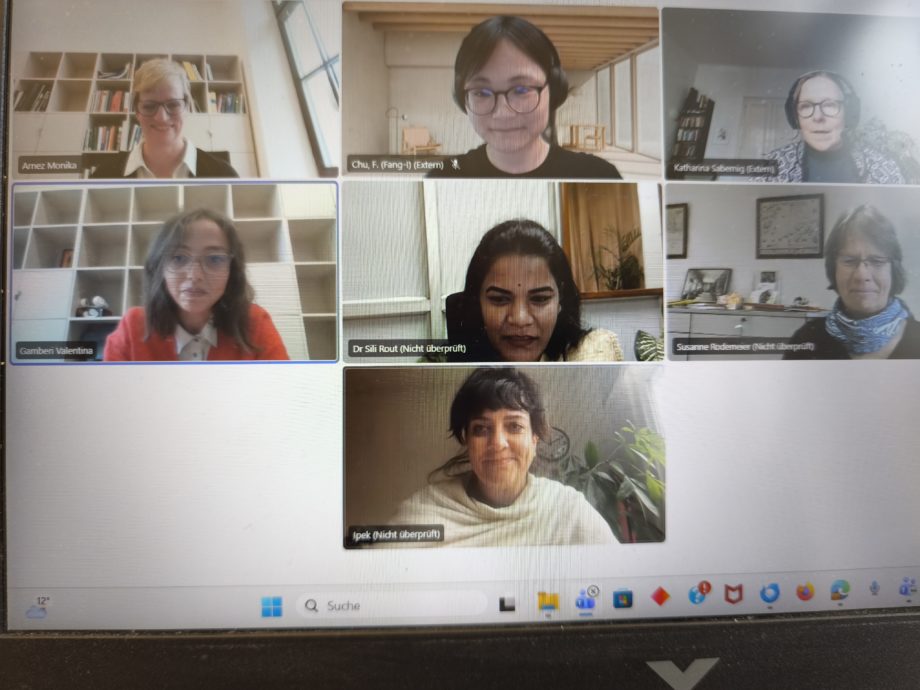
Fig. 1 Screenshot of the participants to the first day of workshop. ©Monika Arnez
Spiritual charges: an overview of tentative definitions and curatorial challenges
With the advent of material religion as a disciplinary focus in recent decades (Morgan 2021), materiality—artefacts, assemblages, architectures, designs, and embodied forms of engagement and knowledge—has increasingly been seen as crucial in mediating and orienting collectivity, shaping shared perception and understanding. This understanding is continually renewed in religious and post-secular rituals (Meyer 2020; Morgan 2018). Museum scholars and practitioners (Buggeln and Plate 2017; de Witte and Meyer 2025; Paine 2013; Winjnia and Bielo 2025) have recognised spiritual qualities in collections. They also note taboos about displaying sacred objects outside traditional contexts (Debrosse 2023; Weiser et al. 2023). In case studies outside Europe, especially in Asia (Go 2020; MacDaniel 2017; Gamberi and Wang 2025; Tythacott and Bellini 2020), scholars show how exhibition designs that replicate or interact with temple spaces prolong or intensify a sense of spirituality in audiences, regardless of the artefacts‘ “authenticity.”
These developments lead curatorial practices to balance respect for sacred objects with museum education, using diverse viewpoints to interpret artefacts’ layered meanings, including spiritual ones (Hodge 2018). University collections, such as the Religionskundliche Sammlung at Philipps-University Marburg, employ diverse artefacts to challenge traditional classifications (Franke and Matter 2022). Local museology (Kreps 2008) prompts curators to involve ritual specialists to respectfully display sacred objects (de Witte and Meyer 2025; Kreps 2008; Tythacott 2017). Collaborations now inform cataloguing and handling guidelines for respectful treatment (Cieslik 2024).
Some scholars criticise museum storytelling, ritual reconstructions, and conservation methods, warning that they can simplify or misrepresent local cultures or fail to meet local expectations. Not all stakeholders align with curators‘ or collaborators‘ views (Martin 2017; Shatanawi 2012). Additionally, efforts at transparency and accessibility can reinforce hierarchies between specialists and community members. As a result, curators must manage spiritual charges in museum spaces while sharing knowledge in innovative yet sensitive ways, including collaborations with contemporary artists that might conflict with local values (Foster 2023).
Advocating for closer collaborations between curators and museum scholars: restituting our workshop
Prompted by ongoing debate among anthropologists (Dreschke et al. 2024; Martínez 2021; Otto et al. 2021; Sansi 2020; Schacter 2020) and other scholars (Bielo and Hayes 2024; Wijnia and Bielo 2025; Gillson 2024), the authors of this DCNtR debate advocate greater collaboration between academic anthropologists and museum practitioners to address curatorial and research challenges. As Emma Martin (2025, 268) provocatively asks in her review of Yunci Cai’s edited volume The Museum in Asia, what could happen if museum and heritage scholars engage with practitioners—those at “the coal face” of negotiating curatorial practices?
This series of Dialogues responds to this provocation by offering a platform for reciprocal support between academics and museum and heritage practitioners in their common efforts to work with the spiritual charges of the curatorial work. In our collective debate, we further elaborated on the concept of “ethnographic fieldwork” as research that encompasses archives, databases, and ritual practices, and that requires engagement with both human and non-human participants and thoughtful self-reflection. Although the majority of scholars who contributed to this DCNtR debate are anthropologists, we argue that the concept of fieldwork can better articulate the tension between researchers‘ and stakeholders’ perspectives once the research is disseminated in curatorial form. On the other hand, curators must conduct research on the topic they would like to put on stage, thereby encountering similar tensions in their work.
For instance, if anthropologists think about their ethnographic research in curatorial terms, they might sharpen their self-reflexivity regarding positionalities and their ethical engagement with research collaborators: as the research will be visible beyond the academic circle, reaching a wider audience, whose actors are empowered in this process? Conceptualising curating as a spiritually charged practice means curating the intersubjective relationships established during fieldwork. What kind of artistic reflections, methods and design thinking can be put in place to ensure the curatorial project is accessible and engaging for the audience whilst respecting ethical principles co-elaborated on in the field? Curators, on the other hand, might find in ethnographic research and in ethnographic cooperation with source communities the knowledge necessary to attune certain artistic interventions, media tools, the treatment of displayed artefacts, and curatorial messages to stakeholders‘ and audiences‘ sensitivities. These considerations are useful for deconstructing assumptions about museums, exhibit designs, and artefacts that are often “disincarnated” and “abstract” in response to academic-scientific requirements or, conversely, rooted in artistic or conservation criteria that are considered standardised and professional in museum practice.
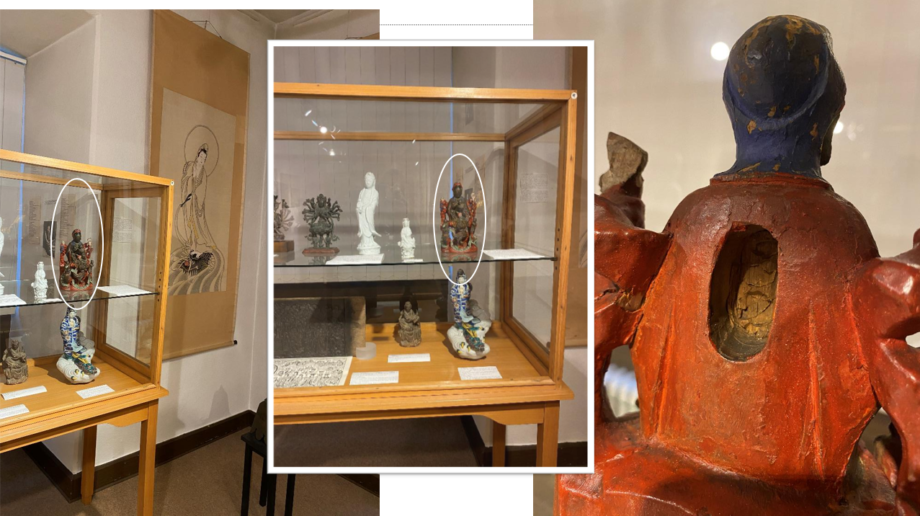
Fig. 2 A slide shared by Susanne Rodemeier during the discussion among participants on the second day of the workshop. The Guanyin statue is visible in the permanent gallery of the Religionskundliche Sammlung, on which Valentina Gamberi based her research. Photo by Susanne Rodemeier, ©Religionskundliche Sammlung
The eight contributions of this DCNtR Debate tackle this reciprocal feedback and support across curatorial and academic circles by presenting projects that either touched upon religious traditions, sacred artefacts, and exhibit designs that can respect and evoke a certain religious tradition or spirituality (Brun, Gamberi, Masoumzadeh, Rodemeier, and Rout), reflected on taboos or topics that are informed by a certain collective spirituality (i.e., the fear of ghosts lingering in cemeteries in Taiwan, as addressed by Chu or perceptions on body parts, as investigated by Sabernig), or elaborate curatorial methodologies informed by specific spiritual concepts (i.e., Sur’s usage of the concepts of qi and yin in Daoism as the methodology of her future curatorial project). In this introduction, we organise the contributions of this DCNtR Debate by six keywords that epitomise challenges from the workshop:
- The positionality of the curator as a researcher and an author; whilst some of the projects or proposals implied a collaboration with local stakeholders, research students, or contemporary artists, in others (Gamberi and Sabernig’s contributions) the curators also produces exhibition artefacts for illustrating their research’s evolution and as a response to the research artefacts’ spiritual charges—usually, as a way through which taboos related to the latter are mitigated. What kind of ethical repercussions do these works have?
- The role of bodies as spiritually charged artefacts and as means of experiencing spiritual charges in and outside exhibitions; all contributions considered audiences and stakeholders as sensing bodies that may react emotionally to exhibitions featuring spiritually charged artefacts. Three contributions (Rodemeier, Chu, and Sabernig) featured human remains or body parts as central to their curatorial projects, prompting discussion on ways to approach or display human remains to audiences;
- The issue of making visible, displayable and accessible for audience abstract religious or cultural concepts; in all projects presented, there are key religious or cultural contexts that are either attached to artefacts and, therefore, fundamental for understanding the meaning and functions of these artefacts, or that cannot be elided in exhibitions presenting and, consequently, might influence or guide exhibit designs and their “atmosphere”. In particular, Brun and Masoumzadeh focused on the methodological and theoretical reflections they elaborated to make Islamic mysticism in the Sufi and Persian traditions tangible for the audience;
- The complex dynamics of collaborating with contemporary artists around spiritual charges; this issue echoes the wider debate on using art in ethnographic collections. On the one hand, Brun showed how artists benefit collections by making complex practices and religious knowledge more accessible. On the other hand, Gamberi’s project argued that artistic interventions can undermine curatorial intent, as artists may not reflect local sensitivities, even if they are stakeholders;
- The issue of displaying and respecting sacred artefacts; all contributions addressed problems from showing spiritually charged artefacts to audiences usually outside local communities and stakeholders. Some suggested using reproductions (Rout and Sabernig) to allow material and sensory knowledge without breaking ritual codes or copyright. However, reproductions have drawbacks, like essentializing religious groups or maintaining taboos and affective associations, even without „authenticity;”
- The issue of appropriating and incorporating religious or cultural concepts into curatorial methods: all projects took into account culturally or spiritually grounded conceptions or practices to both respect stakeholders who might identify with the topic represented in the exhibition and to be inspired in elaborating more inclusive curatorial methods. For instance, Sur’s project utilised key religious concepts in Daoism—such as yin and qi—as tools through which to shape her curatorial methodology. To what extent is this appropriation and elaboration of spiritual concepts and practices possible and viable?
Each contribution in this DCNtR debate introduces its research and curatorial setting, describes the spiritual charges involved, and outlines the curatorial strategies developed. It explains how the shift from research to curation posed challenges and how they were addressed. Each contributor concludes with an evaluation of the project or proposal, taking into account feedback from the other participants during the workshop.
We maintained the central debate and feedback exchange of the workshop by organically linking blog posts that resonated with one another. Susanne Rodemeier’s proposal for a curatorial methodology, part of her teaching on provenance research, contextualises Valentina Gamberi’s curatorial project on a hollowed Guanyin, as the latter comes from the Religionskundliche Sammlung where Susanne works and teaches, while Fang-I Chu expands Valentina’s reflection on Chinese popular religion. Estelle Brun and Sili Rout provide reflections on curatorial interventions in museum institutions representing specific religious traditions, namely Sufism and Indian tribal communities imbued by local cosmologies, whilst Sabernig and Masoumzadeh further build on independent curatorial works grounded in inspiration from Buddhist and Muslim sensitivities.
At the same time, we provided spaces for further elaborations and broader considerations stemming from the overall collective work. These further reflective spaces take the form of commentaries grounded in discussants’ research or curatorial experience, thereby fostering dialogue between scholars and museum practitioners. The first think-piece is offered by the independent curator Ipek M. Sur, who brings a curatorial perspective to the projects of other participants and connects them to her own methods and current project, “Curating the Yin.” The commentary afterwards by Monika Arnez, Professor of anthropology and Head of the Cluster Advancements in Anthropology, draws key conclusions from the debate and offers critical considerations on ethnographic and curatorial work.
References
Berns, Steph. 2017. “Devotional Baggage.” In Religion in Museums, edited by Gretchen Buggeln, Crispin Paine and S. Brent Plate, pp 83 – 91. London: Bloomsbury.
Bielo, James and Matthew Hayes. 2024. “About.”, Collecting Religion.
Bjerregard, Peter. 2015. “Dissolving objects: Museums, atmosphere and the creation of presence.” Emotion, Space and Society 15: 74–81.
Buggeln, Paine and Brent Plate, eds., 2017. Religion in Museums: Global and Multidisciplinary Perspectives. London: Bloomsbury.
Cieslik, Emma. 2024. “Documenting the Divine: The Future of Sacred Objects in Museum Databases.” Collections: A Journal for Museum and Archives Professionals 20(1): 142–155.
Debrosse, Clémentine. 2023. “Exhibiting the taboo of museums of ethnography.” ICOFOM Study Series 51(1-2): 74–83.
de Witte, Marleen and Birgit Meyer. 2025. “Consulting the thing of the spirit: Evidencing unseen presences in missionary collections.” Museum Anthropology 48: e70002.
Dorrian, Mark. 2014. “Museum atmospheres: notes on aura, distance and affect.” The Journal of Architecture 19(2): 187–201.
Dreschke, Anja, Simone Pfeifer and Anna Lisa Ramella. 2024. “Multimodal Digital Curating as (Anthropological) Research, Collaboration, and Engagement.” Allegra Lab.
Duncan, Carol. 1995. Civilizing Rituals: Inside Public Art Museums. London & New York: Routledge.
Franke, Edith and Anna Matter. 2022. “Negotiating Religion in Museums.” In Handling Religious Things: The Material and the Social in Museums, edited by Franke, Edith and Ramona Jelinek-Menke, pp. 23–38. Hildesheim, Zürich & New York: George Olms Verlag.
Foster, Nicola. 2023. “Curators as keepers and exhibition makers: The British Museum’s African Galleries,” Museum History Journal 16(1): 63–80.
Gamberi, Valentina and Shu-Li Wang (2025). “The Hyperreal Sacred: Exploring Buddhist Museums in Taiwan.” Material Religion 21(2): 215–217.
Gillson, Gwendollyn. 2024. “The Affective Obligations of Collecting.” Collecting Religion.
Goh, Aik Sai. 2022. “Enlightenment on Display: the Origins, Motivations, and Functions of Hagiographic Buddhist Museums in Singapore.” Southeast Asian Studies 11(1): 79–114.
Hodge, Christina J. 2018. “Decolonizing Collections-Based Learning: Experiential Observation as an Interdisciplinary Framework for Object Study.” Museum Anthropology 41: 142–158.
Kreps, Christina. 2008. “Appropriate museology in theory and practice.” Museum Management and Curatorship, 23(1): 23–41.
Mäki-Petäjä, Kaisa. 2014. Aesthetic Engagement in Museum Exhibitions. PhD diss., University of Jyväskylä.
Martin, Emma. 2017. “Collecting Tibet: Dreams and Realities.” Journal of Museum Ethnography 30: 59–78.
Martin, Emma. 2025. “The Museum in Asia, Yunci Cai, ed., Leicester Companions to Museum Studies. London: Routledge, 2025.” Museum Worlds: Advances in Research 13: 267–268.
Martínez, Francisco. 2021. Ethnographic Experiments with Artists, Designers and Boundary Objects: Exhibitions as a research method. London: UCL Press.
McDaniel, Justin Thomas. 2017. Architects of Buddhist Leisure: Socially Disengaged Buddhism in Asia’s Museums, Monuments, and Amusement Parks. Honolulu, HI: University of Hawai‘i Press.
Meyer, Birgit. 2020. “Religion As Mediation.” Entangled Religions 11 (3).
Morgan, David. 2018. Images at Work: The Material Culture of Enchantment. Oxford: Oxford University Press.
Morgan, David. 2021. The Thing about Religion: An Introduction to the Material Study of Religions. Chapel Hill, NC: University of North Carolina Press.
Otto, Ton, Jennifer Deger and George E. Marcus. 2021. “Ethnography and exhibition design: Insights from the Moesgaard inaugural.” Design Studies 74: 1–27.
Paine, Crispine. 2013. Religious Objects in Museums: Private Lives and Public Duties. London: Bloomsbury.
Sansi, Roger, ed. 2020. The Anthropologist as Curator. London: Bloomsbury.
Schacter, Rafael. 2020. “A Curatorial Methodology for Anthropology.” In Lineages and Advancements in Material Culture Studies: Perspectives from UCL Anthropology, edited by Timothy Carroll, Antonia Walford, and Shireen Walton, pp. 190–204. London & New York: Routledge.
Shatanawi, Mirjam. 2012. “Curating against Dissent: Museums and the Public Debate on Islam”. In Political and Cultural Representations of Muslims, edited by Christopher Flood, Stephen Hutchings, Galina Miazhevich, and Henri Nickels, pp. 177-192. Leiden: Brill.
Svašek, Maruška. 2012. “Introduction: Affective Moves: Transit, Transition and Transformation,” In Moving Subjects, Moving Objects: Transnationalism, Cultural Production and Emotions, edited by Maruška Svašek, pp. 1–40. Oxford & New York: Berghahn.
Turner, Victor. 1979. “Frame, Flow and Reflection: Ritual and Drama as Public Liminality.” Japanese Journal of Religious Studies 6(4): 465–499.
Tythacott, Louise. 2017. “Curating the Sacred: Exhibiting Buddhism at the World Museum Liverpool.” Buddhist Studies Review 34(1): 115–133.
Tythacott, Louise and Chiara Bellini. 2020. “Deity and Display: Meanings, Transformations, and Exhibitions of Tibetan Buddhist Objects.” Religions 11(3): 106.
Weiser, Elizabeth M., Marion Bertin and Anna Leshchenko. 2023. “Introduction: Challenging the silences: Confronting taboos in museums and museology.” ICOFOM Study Series 51(1-2): 7–16.
Wijnia, Lieke and James Bielo, eds. 2025. Museums as Ritual Sites: Civilizing Rituals Reconsidered. London: Routledge.
Wilkens, Katharina, Christian Meyer, Anna Koch, Petra Tillessen, Annette Wilke. 2011. “Museum in Context.” Journal of Religion in Europe 4(1): 71–101.
Valentina Gamberi was a MSCA-CZ postdoctoral fellow at Palacký University Olomouc from March 2024 to February 2026. She is an anthropologist focusing on museums, material religion and cultural heritage. Beyond journal articles and book chapters, she authored Experiencing Materiality: Museum Perspectives (Berghahn, 2021) and co-edited Haunting Ruins: Ethnographies of Ruination and Decay (Berghahn, 2025). As part of her current postdoctoral project, she curated the online exhibition “Traces of Guanyin” based on ethnographic and archival research. For more information about Valentina’s work, please consult her personal website.