














































 | 06/10/26 |
On Research, Activist Research and “Activist Research”

Modern Geometric Abstraction Pattern. Jayvee Enaguas, 2019. Wikimedia Commons, CC0 1.0.
Is Your Research Activist?
Is your research activist? At first sight, this seems like a straightforward question. Some researchers explicitly understand their work as activist, collaborate with social movements, intervene in public debates, or seek to change policies and institutions. Others insist that their task is primarily analytical: to understand and explain the world rather than to change it. Yet this familiar distinction becomes surprisingly difficult to sustain once we ask what makes research possible in the first place.
The tension is an old one. Karl Marx famously insisted that philosophers had only interpreted the world, whereas the point was to change it (Marx 1938 [1845]). More recently, Vijay Prashad has turned this formulation around by asking whether it is actually possible to know the world without, in some sense, wanting it to be otherwise (Prashad 2020). The provocation unsettles a distinction that debates about activist scholarship often take for granted: between research that merely describes or interprets reality and research that actively intervenes in it.
I want to push this provocation one step further. Research never simply encounters a world already there, waiting to be neutrally described. It necessarily selects: particular phenomena become objects of inquiry, some differences become significant while others recede, certain questions appear worth asking, and particular forms of evidence and explanation become relevant. Research, in other words, always makes the world intelligible from a perspective. In this very broad sense, all research is activist: not because all researchers engage in political activism, but because research inevitably participates in disclosing the world in some ways rather than others.
But researchers differ substantially in whether and how they seek to engage beyond the production of knowledge, collaborate with political actors, advocate particular changes, or intervene directly in social and political processes. In this more specific sense, only some research is activist research.
There is also a third issue. Some research comes to be marked as “activist research” – often by those who represent their own research as simply scholarly, objective, or neutral. Such marking may accurately describe interventionist forms of scholarship. But it can also perform political work: identifying competing perspectives as ideological or activist can serve to delegitimise them while leaving the perspectivisation underlying one’s own position largely invisible.
These three meanings are analytically distinct: all research is activist; some research is activist research; and some research gets marked as “activist research”. The apparent paradox disappears once we recognise that activist means something different in each proposition. Distinguishing them allows us to ask not only whether research is activist, but how research inevitably perspectivises the world, when perspectivisation becomes deliberate engagement and intervention, and what happens when particular forms of research are politically singled out as “activist”.
All Research Is Activist: Perspectivising the World
To say that all research is activist is deliberately provocative. It does not mean that all researchers pursue political goals, let alone that research should be evaluated by its political usefulness. Rather, it starts from a more elementary observation: there is no research without selection. We identify certain phenomena as relevant, turn some into objects of inquiry, formulate particular questions, distinguish what counts as evidence, and mobilise concepts through which that evidence becomes intelligible. Other phenomena, questions, and possible explanations inevitably remain peripheral or disappear from view.
Max Weber captured an important aspect of this problem through his notion of Wertbeziehung or value relevance. Faced with an effectively infinite multiplicity of possible objects and relations, scientific inquiry can only proceed by selecting aspects that become significant in relation to particular value ideas (Weber 1949 [1904]). Crucially, however, value relevance is not the same as a value judgement: values may orient our selection of research problems without determining our empirical findings or scientifically establishing which values we ought to hold. In various forms, this recognition of the situatedness and value relevance of knowledge, without reducing knowledge to arbitrary opinion, has become a broadly established postpositivist position across the social sciences. Recent work on politically charged ethnographic research has similarly argued that acknowledging the political positioning inherent in research remains compatible with demanding the most comprehensive possible consideration of relevant evidence and adequate reconstruction of the perspectives of those we study (Krämer and Zenker 2026).
This insight can be taken one step further. Selection does not merely occur against the background of an otherwise fully intelligible world. It participates in making particular worlds intelligible in the first place. Building on different insights into epistemic violence, systemic closure, and the sociology of absences (Spivak 1988; Luhmann 1995; Santos 2014), I use the term nomocidal closure for this unavoidable process through which some phenomena, distinctions, relations, forms of evidence, and modes of justification become intelligible and relevant, while others become less visible, irrelevant, or even unintelligible. Closure here does not mean error, distortion, or ideological blindness. Some form of closure is a condition of knowledge: without drawing distinctions and temporarily stabilising what counts as an object, a relation, or an explanation, there would be nothing determinate to know.
Nor is there a position outside such closure from which the world could finally be apprehended as it really is. Nomocidal closure is itself no exception: it offers another perspectivisation rather than a view from nowhere. Its purpose is not to expose other perspectives as partial while claiming completeness for itself, but to make the inevitability – and consequences – of perspectivisation available for recursive scrutiny.
This is the first, deliberately broad sense in which all research is activist. By selecting and relating, foregrounding and backgrounding, naming and distinguishing, research participates in making a particular version of the world available for knowledge. This does not make every research project a political intervention. But what becomes visible as a problem, what can count as its cause, and what can appear as a possible alternative depend partly on how the world has been rendered intelligible in the first place.
If activist meant nothing more than this, however, the term would tell us very little. We therefore need a second, narrower meaning of activist research.
Some Research Is Activist Research: From Perspectivisation to Engagement
If all research is activist in this broad sense, we still need a language for distinguishing between different things researchers actually do. Making a world intelligible from a particular perspective is not the same as deliberately seeking to intervene in that world. A scholar publishing an ethnographic analysis, one writing an op-ed, another advising policymakers, and yet another collaborating with a social movement may all produce perspectivised knowledge. But they engage with its practical consequences in quite different ways.
Anthropology has developed a rich vocabulary for such differences. In their classic discussion of engaged anthropology, Setha Low and Sally Engle Merry distinguish forms of engagement ranging from sharing and support through teaching and public education, social critique, collaboration, and advocacy to activism (Low and Merry 2010). What matters here is that engagement is not an either/or property of research. It takes different forms and entails different degrees of researchers actively attempting to affect the social worlds in which they work.
This provides a useful narrower meaning of activist research. What distinguishes it is not that activist research is perspectivised while other research is not, but the mode and degree of engagement and intervention through which researchers seek to act upon the worlds they study. The boundaries are inevitably fuzzy: publishing, teaching, advising, collaborating, advocating, and organising can overlap, and the same project may move between these modes over time. But if we simply called every perspectivised production of knowledge activist research, the concept would become analytically empty. We would lose the important distinction between producing an interpretation that may have political consequences and deliberately organising research practices in order to bring particular consequences about.
At the same time, perspectivisation and intervention should not be separated too neatly. Different descriptions of a problem disclose different causes, responsibilities, actors, and possible courses of action. Perspectivisation therefore helps to constitute the field of possible interventions in the first place.
The apparent paradox can thus be stated more precisely: all research is activist insofar as it perspectivises the world, but only some research is activist research insofar as researchers deliberately engage with and seek to intervene in that world. This raises the next question: what kinds of perspectivisation make what kinds of intervention possible?
Perspectives for Changing the World
If research necessarily perspectivises the world, it matters not only that we perspectivise, but also how. Different perspectivisations bring different phenomena, relations, causes, and agents into view and thereby make different possibilities for action thinkable. Acknowledging the inevitability of nomocidal closure therefore does not entail a quietistic perspectivism in which it ultimately makes no difference which perspective we adopt. On the contrary: it makes the choice and justification of perspectives all the more consequential.
Consider debates about posthumanism. One of their important achievements has been to challenge anthropocentric assumptions by drawing attention to the manifold ways in which humans, non-humans, technologies, and material environments participate in producing social worlds. Yet radically distributing agency across human and non-human assemblages can also have problematic consequences: if agency no longer requires intentionality or a capacity to have acted otherwise, responsibility risks becoming similarly distributed – everyone and therefore, practically, no one can be held responsible. For questions of justice and political intervention, it may therefore be necessary to retain the capacity to identify responsible agents: actors who can deliberate about alternatives, act differently, be appealed to, and be held accountable (Zenker and Wolf 2024). The point is not that this provides the one correct ontology of agency. But neither does the perspectivised character of knowledge render alternative perspectivisations equivalent. They can be assessed in terms of what they allow us to understand, how well they account for the phenomena at stake, and what possibilities for judgement and action they open up or foreclose. Distributed agency may reveal material relations that an intentionalist account misses; but where the question concerns responsibility and political intervention, a perspectivisation capable of identifying responsible agents becomes indispensable if we are to ask who could act differently and where intervention might be directed.
My own research on land reform in South Africa provides a more concrete example. While sharing the normative objective of overcoming enduring racial inequalities in land ownership and supporting more effective redistribution, empirical research gave colleagues and me reasons to doubt whether one prominent political demand – amending the Constitution to explicitly permit expropriation without compensation, on the contested assumption that it did not already do so – would actually achieve this objective. The normative orientation that made these inequalities relevant to our research did not predetermine its empirical findings, nor did those findings dictate what politically ought to be done. At a later stage, however, we deliberately moved towards intervention by bringing together scholars and practitioners with different disciplinary and political perspectives to develop alternatives and feed them into the land-reform debate – creating what we described as a “positioned archive of political alternatives” rather than prescribing a single political solution (Zenker 2025).
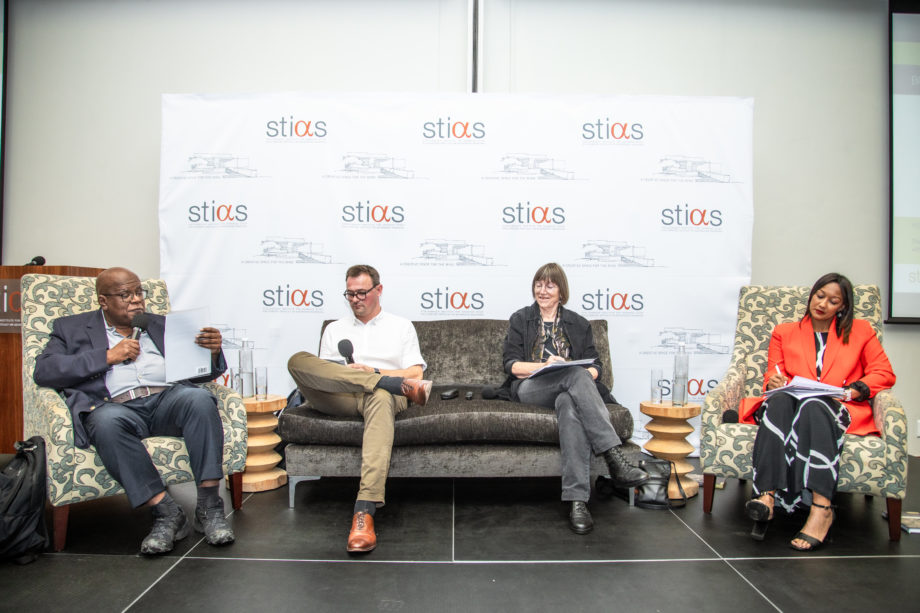
Panel discussion on land reform in South Africa at the Stellenbosch Institute for Advanced Study (STIAS). Photo: Noloyiso Mtembu/STIAS Communication Department, 2024.
The example illustrates why interpretation and intervention should neither be collapsed into each other nor treated as independent. Normative orientations can shape what becomes relevant for research without determining its empirical findings; empirical findings can inform political engagement without dictating a particular political position. Researchers may then make an additional, deliberate choice to intervene on the basis of what their research has made visible.
This returns us to Marx, but with a slight twist. If the point is not only to interpret the world but also to change it (Marx 1938 [1845]), then how we interpret the world partly determines how it can be changed. The question is therefore not whether research should be perspectivised – it cannot be otherwise – but which perspectivisations we can justify, what they make visible, and what forms of action they make possible.
Some Research Is Marked as “Activist Research”
There is, however, a third meaning of activist. Research may be activist in the broad sense of necessarily perspectivising the world and activist research in the narrower sense of deliberately engaging and intervening. But research can additionally be marked by others as “activist research”. Here, the quotation marks matter: activist is not primarily a description of what researchers actually do, but an attribution made from another position.
Nomocidal closure helps to understand how such attributions become possible. Different researchers may render the same world intelligible through different distinctions, categories, standards of relevance, and assumptions about what constitutes a problem. Yet we do not normally experience our own closure as a closure. Once a particular perspectivisation has become sufficiently established, its categories can appear simply descriptive and its assumptions little more than common sense. It is often the other perspective that then becomes visible precisely as a perspective.
Research that foregrounds structural racism, gender inequality, colonial continuities, or environmental injustice may thus be described as “activist” because the relevance it attributes to these phenomena is itself contested. But the same applies in principle in the opposite direction: research foregrounding individual responsibility, social order, economic freedom, national belonging, or the costs of political transformation is no less perspectivised merely because these concerns appear self-evident within another nomocidal closure. This does not make these perspectives empirically or normatively equivalent. It means that none occupies a position outside perspectivisation from which the others can simply be identified as political while remaining unmarked itself.
Calling a position “activist” can of course be a legitimate description of its mode of engagement, and researchers may embrace the term themselves. The problem begins when the label silently shifts from describing engagement to discrediting knowledge. “Activist” can then operate as an epistemic boundary marker, placing particular scholarship on the political side of an imagined boundary between scholarship and politics while competing positions allegedly occupy the apparently unmarked terrain of science, objectivity, or common sense.
This does not mean that accusations of political bias should simply be dismissed. Researchers can selectively use evidence, ignore counter-evidence, or subordinate scholarly standards to desired political conclusions. Politically engaged scholarship is no more exempt from such criticism than any other scholarship. The relevant questions are therefore more concrete: Is an argument empirically warranted? Does it take seriously complicating evidence and adequately represent the positions of those it studies? Are normative commitments made explicit rather than presented as empirical findings? Such standards remain indispensable even if their application can itself never occur from nowhere (Krämer and Zenker 2026).
The issue, then, is not whether the label “activist” is inherently illegitimate, but what it is doing in a particular situation. Does it describe an identifiable form of engagement or intervention? Or does it turn disagreement over perspectives, evidence, or normative commitments into a distinction between supposedly political and supposedly non-political research? Rather than asking simply whether particular research is activist, we should therefore also ask: Who calls whose research “activist,” from within which nomocidal closure – and to what political effect?
Beyond Activism? Three Questions Instead of One
The debate about activist research is often organised around a binary question: should research be activist or not? I have suggested that this conflates three quite different issues. All research is activist insofar as it necessarily perspectivises the world; some research is activist research insofar as researchers deliberately engage and intervene; and some research is marked as “activist research” when particular forms of scholarship are identified as political from within another perspectivisation. Keeping these meanings apart makes the apparent opposition between research and activism both more complicated and more analytically useful.
Acknowledging the perspectivised character of all knowledge cannot, however, be the end of the argument. If there is no view from nowhere, the conclusion is not that it makes no difference how we look at the world. Quite the opposite. We have to take responsibility for the perspectives we adopt: for whether they produce empirically robust knowledge, for what they illuminate and obscure, and for the actors, responsibilities, and possibilities for action they allow us to recognise. Perspectivisation is unavoidable; particular perspectivisations are not.
This is also where Marx’s opposition between interpreting and changing the world can be reconsidered (Marx 1938 [1845]). Interpretation and change remain distinct: understanding something does not itself change it, and empirical findings cannot tell us straightforwardly what ought to be done. Yet neither are they independent. How we make the world intelligible shapes what can appear problematic, who can appear capable of acting, and which alternatives become imaginable.
The challenge, then, is neither to purge research of activism nor to collapse research into activism, but to take responsibility for the perspectives through which we make worlds intelligible – and for the possibilities of acting upon them that these perspectives open up or foreclose.
References
Krämer, Mario, and Olaf Zenker. 2026. “Awkward Alignments: Towards Empathetic Skepticism and Agonistic Confrontation in Anthropological Knowledge-Making.” HAU: Journal of Ethnographic Theory 16 (3). Forthcoming.
Low, Setha M., and Sally Engle Merry. 2010. “Engaged Anthropology: Diversity and Dilemmas: An Introduction to Supplement 2.” Current Anthropology 51 (S2): S203–S226. https://doi.org/10.1086/653837.
Luhmann, Niklas. 1995. Social Systems. Translated by John Bednarz Jr. with Dirk Baecker. Stanford, CA: Stanford University Press.
Marx, Karl. 1938 [1845]. “Theses on Feuerbach.” In The German Ideology, by Karl Marx and Friedrich Engels. London: Lawrence & Wishart.
Prashad, Vijay. 2020. “You Can’t Know the World Unless You’re Trying to Change It.” CAN TV. YouTube video, September 25, 2020. https://www.youtube.com/watch?v=vSk_MXUgtEs.
Santos, Boaventura de Sousa. 2014. Epistemologies of the South: Justice against Epistemicide. Boulder, CO: Paradigm Publishers.
Spivak, Gayatri Chakravorty. 1988. “Can the Subaltern Speak?” In Marxism and the Interpretation of Culture, edited by Cary Nelson and Lawrence Grossberg, 271–313. Urbana: University of Illinois Press.
Weber, Max. 1949 [1904]. “‘Objectivity’ in Social Science and Social Policy.” In The Methodology of the Social Sciences, translated and edited by Edward A. Shils and Henry A. Finch, 49–112. Glencoe, IL: Free Press.
Zenker, Olaf. 2025. “Strategische Netzwerke inmitten konfligierender Positionalitäten: Public Anthropology in der südafrikanischen Landreform.” In Public Anthropology: Wissenspraktiken und gesellschaftliche Interventionen der ethnologischen Fächer, edited by Hansjörg Dilger, Gisela Welz, Beate Binder, and Thomas G. Kirsch, 259–277. Weinheim: Campus Verlag. https://doi.org/10.12907/978-3-593-45943-1_016.
Zenker, Olaf, and Anna-Lena Wolf. 2024. “Towards a New Anthropology of Justice in the Anthropocene: Anthropological (Re)Turns.” Zeitschrift für Ethnologie/Journal of Social and Cultural Anthropology 149 (2): 189–216. https://doi.org/10.60827/zfe/jsca.v149i2.1921.